
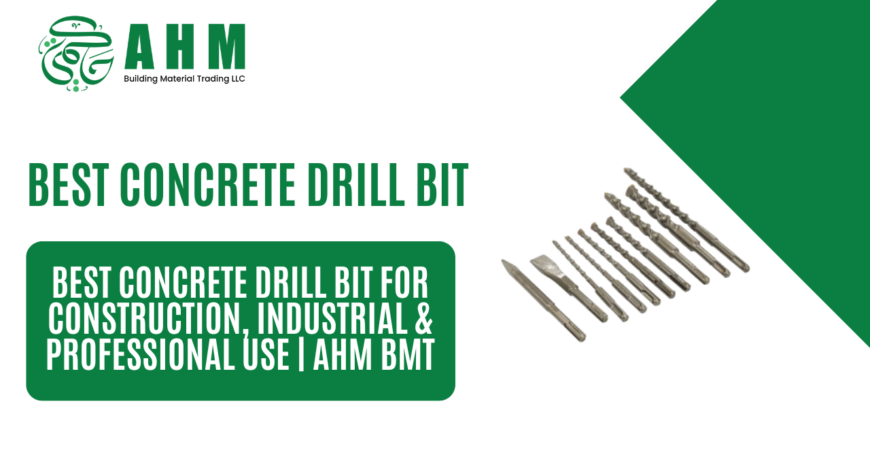
Choosing the best concrete drill bit can make drilling faster, cleaner, and more efficient. Concrete contains cement, hard aggregate, and sometimes steel reinforcement. Therefore, ordinary drill bits often struggle with demanding concrete applications.
The right concrete drill bit depends on the material, hole diameter, drilling depth, drill type, and frequency of use. A small wall-plug installation may need a carbide-tipped masonry bit, while demanding construction work may require an SDS-Plus or SDS-Max rotary hammer bit.
For contractors, electricians, plumbers, HVAC professionals, maintenance teams, and industrial workers in Dubai and across the UAE, selecting the correct drill bit can improve productivity and reduce unnecessary tool wear.
AHM BMT supplies hardware tools and construction products for professional applications across the UAE. This guide explains concrete drill bit types, sizes, materials, SDS systems, cutter designs, applications, drilling techniques, safety considerations, and buying factors.
What Is a Concrete Drill Bit?
A concrete drill bit is a specialized drilling accessory designed to create holes in concrete and other masonry materials. Unlike standard wood or metal drill bits, concrete bits use reinforced cutting tips and bodies designed to withstand impact and abrasion.
Many professional concrete drill bits use carbide at the cutting head. Carbide provides the hardness required to work against concrete and abrasive aggregates.
The bit also uses spiral flutes to remove drilling dust from the hole. Efficient dust removal helps the bit continue cutting and reduces the chance of excessive heat and binding.
The shank also matters. The bit must match the drill’s chuck or tool system. For example, SDS-Plus and SDS-Max bits require compatible rotary hammers.
What Is the best concrete drill bit?
The best concrete drill bit depends on your application.
A carbide-tipped masonry bit can work well for smaller holes and lighter concrete drilling. For regular professional drilling, an SDS-Plus bit paired with a compatible rotary hammer can provide efficient impact drilling.
For larger holes, deeper drilling, and heavy-duty construction applications, SDS-Max systems provide a larger shank and work with more powerful rotary hammers.
Before choosing a concrete drill bit, consider:
- Concrete hardness
- Reinforcement or rebar
- Required hole diameter
- Required hole depth
- Drill type
- Shank compatibility
- Cutter design
- Drilling frequency
- Dust removal
- Required accuracy
Therefore, do not select a bit simply because a supplier describes it as “heavy duty.” Match the bit to the actual drilling requirement.
What Types of Concrete Drill Bit Are Available?
Different drilling jobs require different bit designs. Understanding the main types helps you make a better purchasing decision.
Standard Masonry Drill Bits
Standard masonry drill bits usually feature a carbide cutting tip and work well for smaller holes in concrete, brick, block, and other masonry materials.
They can suit light installation work, wall plugs, small fixings, and general maintenance.
However, demanding concrete drilling may require a hammer drill or rotary hammer instead of a standard drill.
Hammer Drill Bits
Hammer drill bits work with hammer drills that combine rotation with percussion. The impact action helps break masonry while the rotating bit removes material.
They suit many light and medium-duty concrete applications when you pair them with the correct machine.
SDS-Plus Concrete Drill Bit
SDS-Plus bits use a slotted shank that locks into compatible rotary hammers. The system allows the bit to move axially during impact while transferring the machine’s energy effectively.
Contractors commonly use SDS-Plus bits for:
- Concrete anchors
- Wall plugs
- Electrical installations
- Plumbing
- HVAC work
- Brackets
- General construction fixing
SDS-Max Concrete Drill Bits
SDS-Max uses a larger shank system designed for heavier rotary hammers. It suits larger-diameter holes, deeper drilling, and demanding construction work.
SDS-Plus and SDS-Max use different shank systems, so you must match the bit to the machine.
Core Drill Bits
Core bits create larger-diameter openings than conventional concrete drill bits.
Contractors may use core drilling for:
- Pipe penetrations
- HVAC openings
- Electrical services
- Plumbing installations
- Mechanical installations
- Larger construction openings
The required hole size, concrete condition, depth, and machine determine the appropriate core drilling system.
SDS-Plus vs SDS-Max: Which Concrete Drill Bit Should You Choose?
SDS-Plus and SDS-Max serve different drilling requirements.
| Feature | SDS-Plus | SDS-Max |
| Typical use | Light to medium concrete drilling | Heavy-duty concrete drilling |
| Machine | SDS-Plus rotary hammer | SDS-Max rotary hammer |
| Typical holes | Small to medium | Medium to large |
| Common applications | Anchors, fixings, installations | Large holes and demanding construction |
| Tool size | More compact | Larger and heavier |
| Best suited for | General professional work | Heavy-duty applications |
SDS-Plus works well for many routine construction and installation jobs. SDS-Max provides greater capacity for demanding drilling applications.
Always check the drill manufacturer’s specifications before purchasing a bit.
2-Cutter vs 4-Cutter Concrete Drill Bits
Cutter design affects how efficiently a concrete drill bit cuts through the material.
2-Cutter Concrete Drill Bits
Two-cutter bits use two primary cutting edges. They remain common for general concrete and masonry drilling.
They can provide a practical and economical solution for routine applications where workers do not regularly encounter reinforcement.
4-Cutter Concrete Drill Bits
Four-cutter bits use four cutting edges to distribute the cutting action across the head.
Manufacturers often design professional four-cutter bits for demanding concrete applications. Some designs also handle occasional contact with reinforcement more effectively than basic two-cutter bits.
However, cutter count alone does not determine performance. Carbide quality, head geometry, flute design, machine power, and drilling technique also affect results.
Concrete Drill Bit vs Masonry Drill Bit: What’s the Difference?
Concrete forms part of the broader masonry category, so the terms can sometimes overlap. However, manufacturers design different bits for different materials and drilling conditions.
A basic masonry drill bit can work well for brick, block, and lighter concrete applications.
A professional concrete drill bit generally uses stronger construction and may work with hammer drills or rotary hammers.
For hard concrete, frequent drilling, large holes, or demanding construction work, an SDS concrete drill bit can provide a more suitable solution.
Consider the material before choosing:
- Brick: A standard masonry bit may work.
- Concrete block: Use a suitable masonry or hammer drill bit.
- Standard concrete: Use a carbide concrete bit or SDS bit.
- Hard concrete: Consider a professional SDS bit.
- Reinforced concrete: Use a bit designed for the application and consider the reinforcement.
- Large openings: Consider an appropriate core drilling system.
What Features Make a Good Concrete Drill Bit?
A quality concrete drill bit combines several design features to handle demanding drilling conditions.
Carbide Cutting Tip
Carbide provides the hardness required to cut concrete and abrasive aggregates. A suitable carbide tip can maintain cutting performance during repeated drilling.
Strong Bit Body
Concrete drilling produces repeated impact and vibration. Therefore, the steel body must withstand these forces without unnecessary deformation or damage.
Efficient Flute Design
Flutes remove concrete dust from the hole. Efficient dust evacuation helps maintain drilling performance and reduces the chance of binding.
Centering Tip
A centering design helps position the bit before full drilling begins. This feature can improve accuracy when you need to create holes at precise locations.
Compatible Shank
The shank must match your drill. A compatible SDS-Plus or SDS-Max shank helps transfer the machine’s impact energy effectively.
Rebar-Resistant Design
If you regularly work with reinforced concrete, consider a bit designed to handle occasional contact with reinforcement.
How Do You Choose the Right Concrete Drill Bit?
Choosing the right bit becomes easier when you follow a simple selection process.
1. Identify the Material
First, determine exactly what you need to drill.
Consider whether the surface contains:
- Concrete
- Reinforced concrete
- Brick
- Concrete block
- Stone
- Mortar
Harder materials generally require stronger drilling systems.
2. Determine the Hole Diameter
The required hole diameter should come from the anchor, fastener, sleeve, or installation specification.
Do not choose a drill bit simply because its diameter looks similar to the screw.
For fastening applications, follow the manufacturer’s recommended hole size.
You can also use AHM BMT’s drill bit size chart to understand common drill bit sizes and plan your drilling requirements.
3. Check the Required Depth
Measure the required hole depth before selecting the bit.
The working length should provide enough reach for the required hole while leaving sufficient space for dust removal.
4. Match the Drill
Identify the machine you will use:
- Standard drill
- Hammer drill
- SDS-Plus rotary hammer
- SDS-Max rotary hammer
- Core drilling machine
Then choose a compatible bit.
5. Consider Drilling Frequency
Occasional drilling does not require the same specification as continuous professional work.
If your team drills concrete every day, choose a bit designed for repeated use and the specific material.
6. Consider Reinforcement
Reinforced concrete contains steel bars that can affect drilling.
Before drilling structural concrete, identify potential reinforcement and confirm the permitted drilling locations.
Concrete Drill Bit Size Guide
The correct concrete drill bit size depends on the anchor, fastener, sleeve, or installation requirement.
| Drill Bit Size | Typical Application |
| 4–5 mm | Small fixings and light installation |
| 6–8 mm | Common wall plugs and general fixing |
| 10–12 mm | Larger anchors and installation work |
| 14–16 mm | Heavy-duty fixing applications |
| 18–25 mm | Larger anchors and specialist work |
| 25 mm+ | Large or specialist drilling |
These sizes provide general guidance rather than universal recommendations.
Always follow the anchor, fastener, or equipment manufacturer’s specifications for the exact hole diameter.
Which Concrete Drill Bit Is Best for Different Applications?
The best bit changes according to the job.
Concrete Anchors and Wall Plugs
Anchors require accurately sized holes.
Choose the diameter specified by the anchor manufacturer. For many professional fixing applications, an SDS-Plus concrete drill bit can provide efficient drilling.
Electrical Installation
Electricians frequently drill concrete walls and slabs for brackets, conduits, cable supports, and other installations.
Select the bit diameter and working length according to the fixing or service requirement.
Plumbing and HVAC
Plumbers and HVAC professionals may drill concrete walls for pipes, brackets, supports, and service routes.
Small fixing holes can use SDS-Plus bits, while larger penetrations may require core drilling equipment.
Mechanical Installation
Mechanical equipment often requires accurate holes for anchors, brackets, supports, and mounting systems.
Use a bit that provides the correct diameter and depth while matching the capacity of your drill.
Construction Maintenance
Maintenance teams often encounter different concrete surfaces and fixing requirements.
Keeping multiple concrete drill bit sizes available can help teams handle routine installation and repair work without using unsuitable accessories.
For contractors looking for a wider range of professional construction and hardware products, AHM BMT also serves as a hardware tools supplier in UAE.
How to Drill Concrete Correctly
Using the correct technique helps improve drilling performance and reduce unnecessary wear.
Mark the Drilling Location
Mark the exact drilling point before starting.
Accurate marking reduces unnecessary holes and helps workers achieve better installation results.
Check for Hidden Services
Before drilling, check for electrical cables, plumbing lines, reinforcement, and other hidden services.
Never assume that a wall or slab contains no services behind the drilling location.
Select the Correct Drill Mode
Use the operating mode recommended by the drill and bit manufacturer.
A standard drill, hammer drill, and rotary hammer deliver different levels of drilling action.
Start Carefully
Start the hole with controlled pressure. Establish the drilling position before applying greater pressure.
Apply Controlled Pressure
Do not force the bit aggressively into the concrete.
Allow the machine and cutting head to perform the work. Excessive pressure can increase vibration, heat, and tool wear.
Clear the Dust
Concrete drilling produces dust. Withdraw the bit periodically when appropriate to help remove drilling debris from deeper holes.
Use suitable dust extraction or suppression methods where required.
What Happens When a Concrete Drill Bit Hits Rebar?
Reinforced concrete contains steel reinforcement. Therefore, drilling can become more difficult when the bit reaches a reinforcing bar.
A basic two-cutter bit may bind or suffer damage when it strikes steel. Some professional four-cutter and full-head carbide designs can handle certain reinforcement encounters more effectively.
However, workers should not automatically drill through rebar.
If your drilling location intersects structural reinforcement, stop and confirm the project requirements. Moving the hole may provide a safer alternative.
If the project permits cutting reinforcement, use the appropriate equipment and procedure.
The structural importance of reinforcement makes rebar a critical consideration when drilling concrete.
Concrete Drilling Safety Tips
Concrete drilling requires suitable equipment and safe working practices.
Use appropriate:
- Eye protection
- Hearing protection
- Respiratory protection
- Work gloves where appropriate
- Safety footwear
- Dust extraction
- Suitable work clothing
Also inspect the drilling area for electrical cables, plumbing, reinforcement, and other hidden hazards.
Concrete dust can create respiratory hazards, so use appropriate dust-control measures and follow your workplace safety procedures.
Where to Buy Concrete Drill Bits in UAE?
Contractors and maintenance professionals in Dubai and across the UAE need concrete drill bits that match their machines and project requirements.
Before purchasing, check:
- Bit type
- Diameter
- Working length
- Shank system
- Cutter design
- Material compatibility
- Required quantity
- Product availability
- Supplier support
For regular construction requirements, working with an established hardware and industrial supplier can simplify procurement.
AHM BMT supplies hardware tools, building materials, safety equipment, lifting products, rigging products, consumables, and other construction supplies for professional requirements across the UAE.
Choose the Right Concrete Drill Bit for Your Project
The best concrete drill bit is not necessarily the most expensive option. The correct choice depends on the material, hole diameter, depth, drill type, shank, cutter design, reinforcement, and frequency of use.
For light applications, a suitable carbide masonry bit may provide the required performance. For regular professional drilling, SDS-Plus can provide an efficient solution. For larger and heavier applications, SDS-Max can provide the additional capacity required by compatible rotary hammers.
Before purchasing, identify the drilling requirement, check your machine, confirm the required hole size, and select a bit designed for the material.
For contractors, builders, maintenance teams, and industrial businesses in Dubai and across the UAE, AHM BMT provides hardware tools and construction supplies to support professional project requirements.
Why Choose AHM BMT for Concrete Drill Bits?
AHM BMT supports contractors, builders, maintenance teams, procurement professionals, and industrial businesses with construction and hardware products.
Its wider product range allows businesses to source different site requirements from one supplier.
AHM BMT focuses on construction and industrial supply requirements across Dubai and the UAE, including hardware tools, safety products, lifting equipment, rigging products, and consumables.
When selecting a concrete drill bit, businesses should consider the material, required hole size, drilling depth, machine compatibility, and project requirements.
AHM BMT provides a practical sourcing option for businesses looking for construction and hardware products in the UAE.
FAQs
Q1. What is the best drill bit for concrete?
Ans. A carbide-tipped masonry bit can suit lighter drilling, while SDS-Plus or SDS-Max carbide bits suit more demanding professional concrete applications.
Q2. Can you use a regular drill bit for concrete?
Ans. Do not use a standard wood or metal drill bit for concrete. Use a masonry or concrete bit designed for the material and match it with a suitable drill.
Q3. What is the difference between SDS-Plus and SDS-Max?
Ans. SDS-Plus suits many light and medium concrete drilling applications, while SDS-Max supports larger and heavier-duty drilling. They use different shank systems.
Q4. Are carbide drill bits good for concrete?
Ans. Yes. Carbide provides the hardness needed for drilling concrete and masonry and remains widely used in professional concrete drill bits.
Q5. What size drill bit do I need for concrete?
Ans. Choose the diameter specified by the anchor, fastener, sleeve, or installation requirement. Do not select the size based only on screw diameter.
Q6. Which drill bit is best for reinforced concrete?
Ans. A professional bit designed for reinforced concrete can provide better performance. Four-cutter and full-head carbide designs can handle certain reinforcement encounters more effectively than basic two-cutter designs.