
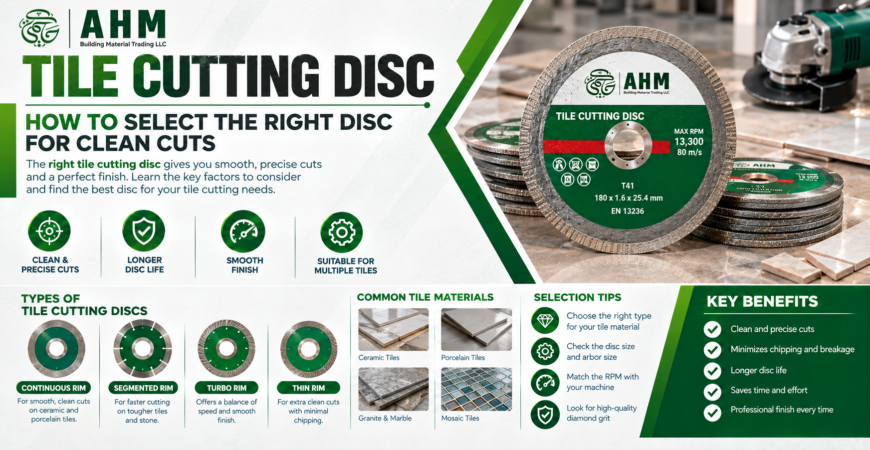
Clean and accurate tile cutting depends on more than the cutting machine itself. The disc you select also plays an important role in controlling the cut, maintaining the required edge finish, and working efficiently with different tile materials.
For contractors, tile installers, renovation teams, and construction professionals in the UAE, selecting the right tile cutting disc starts with identifying the tile material, thickness, cutting method, machine compatibility, and required finish. A properly matched disc can make the cutting process more controlled and suitable for the job.
What Is a Tile Cutting Disc?
A tile cutting disc is a cutting accessory designed for use with compatible equipment to cut tiles and other hard materials according to the disc’s intended application.
Tiles can differ in hardness, thickness, composition, and surface characteristics. Ceramic and porcelain tiles, for example, can have different cutting requirements. Because of this, a disc should not be selected only by its size or appearance.
Important factors to consider include:
- Tile material
- Tile thickness
- Disc diameter
- Bore size
- Machine compatibility
- Cutting depth
- Operating speed
- Wet or dry cutting method
- Required edge finish
- Manufacturer’s recommended application
The right combination of disc, machine, and cutting technique can help create more controlled and consistent results.
Why Choosing the Right Tile Cutting Disc Matters
Tile installation frequently involves more than making simple straight cuts. Installers may need to cut tiles around walls, corners, pipes, drains, electrical points, fixtures, and other installation areas.
A suitable disc allows the operator to work according to the material and cutting requirements. An unsuitable disc, on the other hand, can make the process more difficult and may contribute to chipped edges, rough cuts, excessive pressure, or unnecessary disc wear.
For professional tile work, disc selection should therefore be considered before the cutting process begins.
Types of Tile Cutting Discs
Different disc designs are intended for different cutting applications. The most appropriate option depends on the material, machine, cutting method, and desired result.
Continuous-Rim Diamond Disc
A continuous-rim diamond disc has a continuous cutting edge rather than separate segments. This type of design is commonly associated with applications where controlled cutting and a clean edge are important.
AHM BMT’s diamond cutting disc content notes that continuous-rim designs can be suitable for certain tile, ceramic, porcelain, and stone applications.
For tile work, always verify that the particular disc is suitable for the material being cut.
Segmented Diamond Disc
Segmented discs have separate sections around the cutting edge. The spaces between segments can assist with material removal during suitable cutting applications.
Segmented designs are commonly associated with construction materials and heavier cutting applications. However, they should not automatically be considered suitable for every tile.
The product specification should always be checked before use.
Turbo Diamond Disc
Turbo discs feature a patterned or serrated cutting edge. This design can provide a balance between cutting action and control for suitable hard-material applications.
The exact performance depends on the disc design, material, machine, and operating conditions, so the manufacturer’s application guidance should be followed.
Electroplated Diamond Blade
An electroplated blade has diamond particles attached to the working edge through an electroplating process. This type of construction can be used for specialized cutting applications where the product specification permits.
AHM BMT lists an electroplated blade as part of its cutting-product range.
Tile Cutting Disc Comparison
| Disc Type | Cutting Edge | General Application | Finish Consideration |
| Continuous-rim diamond disc | Continuous | Suitable tile and hard-material applications | Controlled cutting |
| Segmented diamond disc | Separate segments | Construction and material-removal applications | Depends on material and technique |
| Turbo diamond disc | Patterned/serrated | Various hard-material applications | Balance of cutting and control |
| Electroplated blade | Diamond-coated edge | Specialized applications | Depends on material and product specification |
This comparison provides general guidance. Always check the product specifications before selecting a disc for a specific tile or machine.
How to Select the Right Tile Cutting Disc
Choosing the right disc becomes easier when the selection process is handled step by step.
1. Identify the Tile Material
The first step is to identify exactly what you need to cut.
Ceramic, porcelain, marble, and other tile or stone materials can have different cutting characteristics. A disc suitable for one material should not automatically be used for another.
Always confirm material compatibility before starting the job.
2. Check the Tile Thickness
Tile thickness can affect the cutting requirements.
A thin wall tile and a thicker floor tile may require different cutting approaches. Measure the material and consider the required cutting depth before selecting the disc and machine combination.
3. Match the Disc to the Machine
The disc must be compatible with the equipment being used.
Check:
- Disc diameter
- Bore size
- Machine type
- Maximum operating speed
- Mounting arrangement
- Required cutting depth
A disc should not be installed simply because it physically fits the machine. Compatibility must be confirmed according to the relevant specifications.
4. Consider the Type of Cut
Consider the type of cut required before selecting the disc.
Straight cuts, edge trimming, corner cuts, and openings can have different requirements. If the cut will remain visible after installation, edge quality may be particularly important.
5. Choose the Appropriate Cutting Method
Wet and dry cutting can serve different applications.
Wet cutting uses water during the operation and can assist with heat and dust management in suitable applications. Dry cutting can be useful where water is impractical but may require greater attention to heat and airborne dust.
The correct method depends on the equipment, material, working environment, and manufacturer’s instructions.
6. Check the RPM
Operating speed is an important compatibility and safety consideration.
Compare the disc’s maximum rated RPM with the machine’s operating speed before installation. The disc should always be operated within its specified limits.
7. Consider the Required Finish
The required edge finish should also influence your choice.
A visible tile edge may require greater attention to cutting control than a cut that will be covered by another material or installation component.
Choose the disc according to the finish required for the project.
Common Applications of Tile Cutting Discs
A suitable cutting disc can support different tile and hard-material applications.
Floor Tile Cutting
Floor tiles often require straight cuts along walls, doorways, corners, and other boundaries.
Accurate measurements combined with a suitable cutting setup can help installers achieve the required dimensions.
Wall Tile Cutting
Wall tile installation can require cuts around switches, pipes, fittings, corners, and other obstacles.
A suitable disc and controlled cutting technique can make these applications easier to manage.
Porcelain Tile Cutting
Porcelain can require careful cutting because of its material characteristics and the importance of maintaining an acceptable edge.
The selected disc should specifically be suitable for porcelain and compatible with the machine.
Ceramic Tile Cutting
Ceramic tiles can require straight cuts, corner cuts, and openings depending on the installation.
The disc should be selected according to the specific ceramic tile and cutting equipment.
Marble and Stone Tile Cutting
Stone-based tiles require a cutting solution appropriate for the particular material.
For finishing work after cutting, AHM BMT also lists a marble polishing disc as part of its product range.
Tile Cutting Disc vs Other Cutting Products
Different cutting products are designed for different applications. They should not be treated as interchangeable.
| Product | Main Application Focus | Selection Consideration |
| Tile cutting disc | Tile and compatible hard materials | Material and machine compatibility |
| Diamond blade | Suitable hard-material cutting | Product-specific application |
| Circular saw blade | Sawing applications | Machine and material compatibility |
| Metal cutting disc | Metal cutting | Suitable metal applications |
| Marble polishing disc | Surface finishing | Marble finishing requirements |
AHM BMT’s current cutting-product range includes diamond cutting products, electroplated blades, metal cutting discs, marble polishing discs, circular saw blades, and diamond blades.
Practical Tips for Cleaner Tile Cuts
Mark the Cutting Line Clearly
Accurate marking provides a clear reference before cutting begins.
For longer straight lines, a chalk line set can be useful for creating visible reference lines during construction and tiling work. AHM BMT lists its chalk line set under building materials.
Support the Tile Properly
Make sure the tile is positioned securely before cutting. Unstable material can make it harder to maintain a controlled cutting path.
Avoid Excessive Pressure
Do not force the disc through the tile. Use controlled movement and allow the cutting equipment to operate according to its intended use.
Check the Disc Before Use
Inspect the disc before installation and operation. Do not use a disc that is visibly damaged or otherwise unsuitable for the intended application.
Keep the Cutting Area Controlled
Tile and construction-material cutting can create dust and particles. Use appropriate ventilation, extraction, dust-control measures, and protective equipment for the working environment.
Common Mistakes to Avoid
Choosing a Disc Only by Diameter
Disc diameter is important, but it is not the only selection factor. Material compatibility, bore size, RPM, machine type, and application must also be considered.
Using the Same Disc for Every Material
A disc designed for one application should not automatically be used for another material.
Always check the product’s intended use.
Ignoring the Required Finish
A rough cut may be unsuitable where the tile edge remains visible. Consider the final installation before choosing the disc.
Applying Too Much Pressure
Excessive pressure can make the cutting process less controlled. Use an appropriate technique for the material and equipment.
Ignoring Operating Speed
Always confirm that the disc’s rated operating speed is compatible with the machine.
AHM BMT Products for Tile and Cutting Applications
AHM BMT supplies a range of cutting and construction products for professional applications in Dubai and across the UAE. Its website currently lists cutting products and construction consumables among its broader product range.
For compatible hard-material cutting applications, the diamond cutting disc is one relevant option in the AHM BMT range.
For specialized applications, the electroplated blade provides another cutting-product option.
For marble-related projects where surface finishing is required, the marble polishing disc can be considered separately from the cutting stage.
Professionals working with suitable sawing applications can also review the circular saw blade according to their equipment and material requirements.
For tile installation itself, tile spacers are another relevant product from the AHM BMT range and can be used as part of the installation process.
Each product should be selected according to its intended application and specifications rather than treated as a general-purpose alternative.
AHM BMT Consumables for Construction Projects
Cutting products are part of the wider group of supplies required for construction, maintenance, renovation, and installation work.
AHM BMT provides a dedicated consumables category containing products used across different professional applications.
For contractors, installers, procurement teams, and maintenance professionals in the UAE, reviewing related consumables can make it easier to identify products needed for different stages of a project.
The important step is to match each product with the material, equipment, and application before purchase or use.
Why Proper Disc Selection Matters for UAE Projects
Tile installation is common across residential, commercial, retail, hospitality, and renovation projects in the UAE. Accurate cutting can be important when tiles need to fit around walls, corners, fixtures, pipes, and other installation points.
For professional users, selecting the disc according to the actual material and machine can help create a more appropriate cutting setup.
AHM BMT is based at Naif Bazaar Center in Nakheel, Dubai, and supplies building materials, hardware tools, consumables, safety equipment, rigging, lifting products, and paint items.
Tile Cutting Disc Selection Checklist
Before purchasing or installing a disc, check the following:
- Identify the tile material.
- Check tile thickness.
- Confirm the required cutting depth.
- Check the machine type.
- Confirm disc diameter.
- Confirm bore size.
- Check maximum RPM.
- Determine whether wet or dry cutting is appropriate.
- Consider the required edge finish.
- Confirm the manufacturer’s recommended application.
- Inspect the disc before use.
- Use suitable protective equipment.
Following this checklist can reduce selection errors and help create a more suitable cutting setup.
Conclusion
Selecting the right tile cutting disc requires more than choosing a disc that fits the machine. Material type, tile thickness, disc design, diameter, bore size, operating speed, cutting method, and desired finish all need to be considered.
Continuous-rim, segmented, turbo, and electroplated designs have different characteristics and applications. The product specification should therefore be checked before using any disc on a particular tile.
For contractors, tile installers, renovation teams, and construction professionals in the UAE, AHM BMT provides a range of cutting products and construction consumables that can support different project requirements.
A careful selection process helps ensure that the disc and machine are appropriately matched to the job, creating a more controlled approach to tile cutting.
FAQs:
1. What is a tile cutting disc used for?
A tile cutting disc is used with compatible cutting equipment to cut tiles and other materials for which the disc is specifically designed.
2. Which disc is suitable for clean tile cuts?
A suitable continuous-rim diamond disc can be appropriate for compatible tile applications where controlled and clean cutting is required. Always confirm the manufacturer’s specifications.
3. Can one tile cutting disc cut every type of tile?
No. Different tiles can have different cutting requirements. Always check whether the disc is suitable for the specific material.
4. How do I choose the right disc size?
Consider the machine, tile thickness, required cutting depth, disc diameter, and bore size. The disc must be compatible with the equipment.
5. Is wet cutting better than dry cutting?
Neither method is universally suitable for every application. The appropriate method depends on the tile, equipment, working environment, and manufacturer’s instructions.
6. Why do tiles chip while cutting?
Chipping can have several causes, including an unsuitable disc, excessive pressure, incorrect technique, unsuitable machine settings, or incompatibility between the disc and material.
7. Can a diamond blade be used for tile cutting?
Some diamond blades are designed for tile and other hard-material applications. However, not every diamond blade is suitable for every tile, so the product specification should be checked.
8. How should a tile cutting disc be stored?
Store the disc in a suitable protected location where it will not be damaged. Inspect it before use and follow the manufacturer’s storage recommendations.
9. What safety equipment is recommended when cutting tiles?
Appropriate protection may include eye or face protection, hearing protection, suitable footwear, and respiratory protection where required by the working environment.
10. Where can professionals find cutting products in the UAE?
AHM BMT supplies cutting products and construction consumables from its Dubai operation for professional and project requirements across the UAE.