
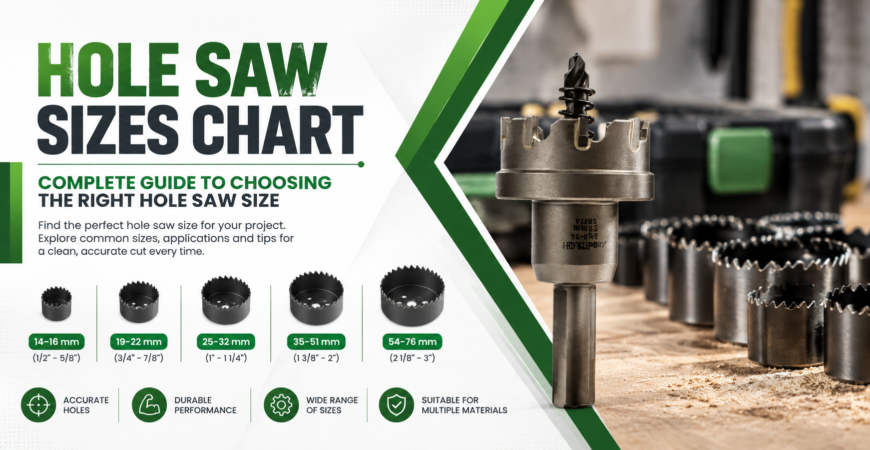
Choosing the correct hole saw size directly affects cutting accuracy, installation quality, and tool life. A hole saw sizes chart helps contractors, electricians, plumbers, HVAC technicians, fabricators, and maintenance teams select the right diameter before starting work.
At AHM BMT, we help professionals choose suitable cutting tools for construction, electrical, plumbing, HVAC, fabrication, and maintenance applications. Our range includes TCT and metal hole saw solutions, supported by a wider selection of construction consumables.
The right hole saw should match the required hole diameter, material, cutting depth, machine, and application. Using an incorrect size can create oversized holes, poor fitting, excessive vibration, or premature tooth wear.
This guide explains common hole saw sizes, applications, measurement methods, hole saw types, and practical selection tips.
What Is a Hole Saw?
A hole saw is a circular cutting tool that creates large, round openings in materials. Unlike a standard drill bit, it removes material around the circumference instead of removing the entire center.
A typical hole saw assembly includes:
- Cutting cup
- Cutting teeth
- Pilot drill
- Arbor
- Mounting system
The pilot drill starts the hole and helps guide the cutting cup. The teeth then cut around the required diameter.
Hole saws are widely used for electrical conduit, pipe installation, plumbing, HVAC openings, cable routing, woodworking, metal fabrication, and construction work. AHM BMT’s existing hole saw guide also identifies construction, electrical, plumbing, HVAC, woodworking, and metal fabrication as common applications.
Hole Saw Sizes Chart: Common Diameters and Applications
The following hole saw sizes chart provides a practical starting point for common installation work.
| Hole Saw Size | Approx. Imperial Size | Common Applications |
| 14 mm | 9/16 in | Small cable entry |
| 16 mm | 5/8 in | Small conduit openings |
| 20 mm | 13/16 in | Electrical conduit |
| 22 mm | 7/8 in | Small pipe and cable work |
| 25 mm | 1 in | Pipe and cable installations |
| 32 mm | 1-1/4 in | Cable management |
| 35 mm | 1-3/8 in | Electrical and plumbing |
| 40 mm | 1-9/16 in | Plumbing applications |
| 45 mm | 1-3/4 in | Pipe and fitting openings |
| 50 mm | 2 in | HVAC and plumbing |
| 60 mm | 2-3/8 in | Larger service openings |
| 65 mm | 2-9/16 in | Ventilation openings |
| 75 mm | 3 in | HVAC and industrial work |
| 80 mm | 3-1/8 in | Pipe and service openings |
| 100 mm | 3-15/16 in | Large pipe openings |
| 125 mm | 4-15/16 in | Larger installation openings |
| 152 mm | 6 in | Commercial and ventilation work |
Important: Sizes and availability vary by manufacturer and hole saw series. Always confirm the actual diameter marked on the cutter before cutting.
AHM BMT’s existing hole saw guide groups of small cutters around 14–32 mm, medium cutters around 35–64 mm, and larger cutters around 65–152 mm and above.
How Do You Choose the Correct Hole Saw Size?
The best hole saw size depends on the finished hole required, not simply the size of the pipe or component passing through it.
For example, if a pipe requires clearance around its outside diameter, choosing a hole saw with exactly the same diameter may produce an opening that fits too tightly.
Before selecting a cutter, check these five factors:
1. Measure the Required Hole Diameter
First, determine the diameter of the opening required for your installation.
Measure the outside diameter of the component when necessary. Then consider the required clearance based on the installation method.
For electrical boxes, pipes, fittings, vents, and cable entries, follow the installation specifications rather than guessing the clearance.
2. Identify the Material
Different materials require different cutting teeth and tool designs.
For example:
- Wood requires suitable wood-cutting teeth.
- Sheet metal requires an appropriate metal hole saw.
- Stainless steel needs a cutter designed for demanding metal applications.
- Plastics require controlled cutting to prevent melting.
- Hard materials may require carbide or diamond cutting technology.
AHM BMT supplies a TCT Holesaw designed for materials including metal, wood, plastic, and composite surfaces. Its tungsten carbide-tipped teeth provide wear resistance and heat resistance.
3. Check the Cutting Depth
Diameter alone does not determine whether a hole saw will complete a job.
The cutter must also provide enough cutting depth for the material.
This becomes especially important when cutting:
- Thick timber
- Multiple layers
- Thick metal sheets
- Composite panels
- Construction materials
Always compare the hole saw’s cutting depth with the thickness of the workpiece.
4. Match the Arbor and Machine
The hole saw must fit the arbor and drilling machine correctly.
Check:
- Arbor compatibility
- Pilot drill compatibility
- Chuck capacity
- Machine type
- Manufacturer’s recommended operating conditions
A correctly sized cutter can still perform poorly if the arbor does not match the machine.
5. Consider the Clearance Requirement
A hole for a pipe often needs clearance around the pipe.
Therefore, do not automatically select a cutter equal to the pipe’s nominal size.
Measure the actual requirement and select the closest suitable hole saw diameter.
Small, Medium, and Large Hole Saw Sizes
Understanding size groups makes selection easier when you work across different applications.
Small Hole Saw Sizes
Small hole saws generally cover approximately 14–32 mm.
These sizes work well for:
- Cable entries
- Small conduits
- Electrical installations
- Small fittings
- Compact service openings
Electricians often need smaller cutters because cable and conduit installations require controlled openings.
Medium Hole Saw Sizes
Medium sizes generally range from approximately 35–64 mm.
They suit:
- Plumbing
- Electrical boxes
- HVAC installations
- Pipe penetrations
- General construction work
This range offers excellent versatility for contractors because many routine installation jobs require medium-diameter openings.
Large Hole Saw Sizes
Large cutters generally start around 65 mm and can extend beyond 150 mm.
They are useful for:
- Ventilation
- HVAC systems
- Large pipework
- Industrial installations
- Commercial service openings
Large hole saws require greater control because their diameter creates more cutting resistance.
Which Type of Hole Saw Should You Choose?
Hole saw diameter represents only one part of the selection process. The tooth material and cutter design also matter.
TCT Hole Saw
A TCT hole saw uses tungsten carbide-tipped teeth.
It can provide strong wear resistance and efficient cutting across demanding applications. AHM BMT describes its TCT Holesaw as suitable for metal, wood, plastic, and composite surfaces, including applications involving stainless steel, aluminium, and hardwood.
Explore the TCT Holesaw from AHM BMT when you need a carbide-tipped cutting solution.
Metal Hole Saw
Metal hole saws are designed for metal cutting applications.
They are commonly used for:
- Steel sheets
- Aluminium
- Stainless steel
- Fabrication work
- Industrial maintenance
Select the cutter according to the metal type, thickness, required diameter, and machine.
AHM BMT supplies metal holesaw solutions for professional construction, fabrication, and metalworking requirements.
Bi-Metal Hole Saw
Bi-metal hole saws combine cutting hardness with body flexibility. They are commonly used for general-purpose cutting across materials such as wood, plastic, and sheet metal.
They can be a practical choice for contractors who regularly switch between different applications.
Diamond Hole Saw
Diamond hole saws use an abrasive diamond cutting surface rather than conventional teeth.
They suit specialized hard and fragile materials such as ceramic, porcelain, glass, and certain masonry applications.
Always verify the manufacturer’s material recommendations before cutting.
Hole Saw Size vs Pipe Size: What Is the Difference?
This is one of the most important points when using a hole saw sizes chart.
A pipe size does not always equal the actual outside diameter of the pipe.
Pipe systems may use nominal sizing. Therefore, selecting a hole saw based only on the pipe’s stated nominal size can produce an incorrect opening.
For installation work:
- Check the actual outside diameter.
- Determine the required clearance.
- Check the fitting or installation specification.
- Select the closest suitable hole saw.
- Confirm the cutter diameter before drilling.
This approach prevents unnecessary rework.
What Are Hole Saws Used For?
Hole saws support many professional applications.
Electrical Installation
Electricians use hole saws to create openings for:
- Conduits
- Cable entries
- Electrical boxes
- Fixtures
- Wiring routes
The correct diameter helps installers achieve cleaner and more controlled openings.
Plumbing
Plumbers use hole saws for pipe penetrations through suitable materials.
A correctly selected diameter helps maintain clearance without creating unnecessarily large openings.
HVAC Installation
HVAC contractors often require larger openings for ducts, vents, pipes, and service connections.
Large hole saw sizes can simplify these installation tasks when the material and cutter are compatible.
Metal Fabrication
Fabricators use suitable metal hole saws to create accurate openings in metal sheets and panels.
The cutter must match the metal type and thickness.
Woodworking
Carpenters use hole saws for furniture, cabinetry, timber construction, and service openings.
The correct tooth design helps produce a cleaner hole while reducing unnecessary material removal.
How to Read a Hole Saw Sizes Chart Correctly
A hole saw chart should not be treated as a universal recommendation.
Instead, use it as a diameter reference.
Check these details before choosing:
| Selection Factor | What to Check |
| Diameter | Required finished hole |
| Material | Wood, metal, plastic, masonry, etc. |
| Thickness | Required cutting depth |
| Cutter Type | TCT, bi-metal, diamond, or other |
| Arbor | Machine compatibility |
| Pilot Bit | Correct size and compatibility |
| Application | Plumbing, electrical, HVAC, fabrication |
| Clearance | Required space around the component |
This process gives you a more reliable selection than choosing a cutter based only on diameter.
Common Hole Saw Selection Mistakes
Even experienced users can choose the wrong cutter when they overlook application details.
Choosing the Pipe’s Nominal Size
Do not assume nominal pipe size equals outside diameter. Always verify the actual dimension.
Using the Wrong Tooth Type
A cutter designed for one material may perform poorly on another. Match the tooth design with the workpiece.
Ignoring Material Thickness
A correct diameter does not guarantee sufficient cutting depth.
Using Excessive Force
Forcing the cutter can increase heat, vibration, tooth wear, and damage.
Allow the cutting teeth to perform the work while maintaining suitable control.
Ignoring Machine Compatibility
Check the arbor, chuck, pilot bit, and machine before beginning the job.
Selecting Only by Price
The cheapest hole saw may not provide the best value for repeated professional use. Consider durability, cutting performance, application suitability, and replacement frequency.
How to Use a Hole Saw More Effectively
Correct technique helps improve cutting quality and tool life.
Mark the Center
Mark the exact center of the required opening before starting.
Secure the Workpiece
Secure the material properly. Movement can cause vibration and inaccurate holes.
Start the Pilot Drill Carefully
Allow the pilot bit to establish the cutting position before applying normal cutting pressure.
Maintain Control
Keep the drill stable and avoid forcing the cutter.
Clear Cutting Debris
Remove chips and debris when necessary, especially during deeper cuts.
Follow Manufacturer Guidance
Always follow the cutter manufacturer’s recommendations for operating conditions, material compatibility, and safety.
Why Choose AHM BMT for Hole Saw Solutions in UAE?
AHM BMT supports contractors, maintenance teams, fabricators, MEP professionals, and industrial buyers across Dubai and the UAE.
The company supplies construction materials, hardware tools, safety equipment, rigging products, lifting products, and consumables.
Wide Range of Cutting Consumables
Professionals can source different cutting and drilling solutions through the AHM BMT consumables range.
This makes procurement easier when a project requires multiple consumable products.
TCT Hole Saw Options
AHM BMT supplies TCT hole saws for demanding cutting applications involving materials such as metal, wood, plastic, and composites.
The carbide-tipped design supports durability and heat resistance during suitable applications.
Metal Hole Saw Solutions
Metalworking projects require appropriate cutting tools. AHM BMT provides metal hole saw products for construction, fabrication, and related applications.
Practical Product Support
Choosing a hole saw involves more than selecting a diameter.
You may need to consider the material, thickness, arbor, pilot drill, machine, and application. AHM BMT can help buyers identify a suitable solution based on their project requirements.
One Supplier for Multiple Requirements
AHM BMT provides access to a broader range of construction and industrial supplies. This helps contractors and procurement teams simplify purchasing across different project requirements.
Conclusion
A reliable hole saw sizes chart makes cutter selection easier, but diameter alone should not determine your choice. You also need to consider the material, thickness, required clearance, cutter type, arbor, pilot drill, and machine.
Small sizes suit cable and conduit work. Medium sizes support plumbing, electrical, and HVAC installations. Larger cutters work well for ventilation, pipework, and industrial openings when the tool and machine match the application.
For professional cutting requirements in Dubai and the UAE, AHM BMT provides TCT hole saws, metal hole saws, and a wider range of construction consumables. The right product selection helps contractors achieve cleaner openings, improve efficiency, and reduce unnecessary tool wear.
FAQs
Q1. What is the most common hole saw size?
Ans. Common sizes vary by application. Sizes around 20–50 mm frequently suit electrical, plumbing, and general installation work.
Q2. How do I choose a hole saw size?
Ans. Measure the required opening first. Then consider material, clearance, thickness, cutter type, and machine compatibility.
Q3. Is a 50 mm hole saw exactly 50 mm?
Ans. A 50 mm hole saw is designed to cut approximately a 50 mm diameter opening. Always verify the manufacturer’s stated cutting diameter.
Q4. Can one hole saw cut every material?
Ans. No. Different materials require different tooth designs and cutting technologies. Select the cutter according to the workpiece.
Q5. What is the difference between TCT and metal hole saws?
Ans. TCT hole saws use tungsten carbide-tipped teeth and support several demanding materials. Metal hole saws focus specifically on metal-cutting applications.
Q6. Does pipe size equal hole saw size?
Ans. Not necessarily. Nominal pipe size may differ from the pipe’s actual outside diameter. Always check the actual dimensions and required clearance.