
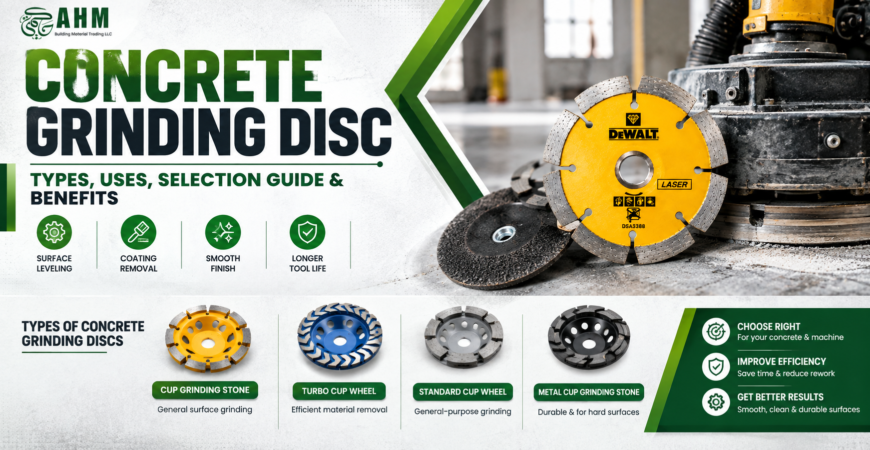
A concrete grinding disc removes surface imperfections, smooths rough concrete, and prepares floors for finishing. Contractors use these discs for concrete leveling, coating removal, surface preparation, edge grinding, and repair work.
For professional construction and maintenance projects in Dubai and the UAE, AHM BMT provides reliable grinding and cutting solutions for demanding applications. Its range includes cup grinding stones, turbo cup wheels, standard cup wheels, and metal cup grinding stones. These products form part of AHM BMT’s wider construction consumables range.
Choosing the right disc depends on concrete hardness, grinding depth, required finish, machine type, and application. The wrong disc can grind slowly, wear quickly, or create excessive heat and vibration.
This guide explains how concrete grinding discs work, which types professionals use, how to choose one, and how AHM BMT supports concrete grinding requirements.
What Is a Concrete Grinding Disc?
A concrete grinding disc is an abrasive tool designed to remove and shape hardened concrete surfaces.
Most professional concrete grinding discs use diamond segments or abrasive materials. The cutting surface gradually removes concrete as the grinding machine rotates.
Depending on the design, a disc can perform:
- Surface leveling
- Concrete smoothing
- Coating removal
- Paint removal
- Adhesive removal
- Edge grinding
- Surface preparation
- Minor surface correction
- Preparation before coating or flooring
Unlike a conventional cutting disc, a grinding disc focuses on surface removal rather than creating a narrow cut.
AHM BMT supplies different grinding products for construction and industrial applications, allowing professionals to select the tool according to their grinding requirements.
How Does a Concrete Grinding Disc Work?
A concrete grinding disc works through controlled abrasive action.
When the disc rotates, its abrasive or diamond cutting elements contact the concrete. These elements gradually break down and remove small amounts of surface material.
The grinding result depends on several factors:
- Diamond or abrasive quality
- Segment design
- Bond hardness
- Concrete hardness
- Disc diameter
- Machine speed
- Applied pressure
- Grinding technique
A harder concrete surface does not automatically require the hardest grinding disc. In many cases, the correct bond and segment configuration matter more.
Therefore, professionals should select the disc based on the actual concrete and desired result.
What Are the Main Types of Concrete Grinding Discs?
Different disc designs provide different grinding characteristics. Understanding these options helps contractors choose a suitable product.
Cup Grinding Stone
A cup grinding stone provides a broad grinding surface for concrete and masonry applications.
Its cup-shaped construction supports surface grinding and material removal while providing stability during operation.
AHM BMT offers a cup grinding stone for professionals who need a suitable grinding solution for construction and related applications.
This type can help with:
- Concrete surface preparation
- Rough surface correction
- Masonry grinding
- General material removal
- Surface smoothing
The correct machine compatibility remains essential before use.
Turbo Cup Wheel
A turbo cup wheel uses a segmented or continuous turbo-style arrangement to support efficient grinding.
The segment arrangement helps provide a balance between material removal and surface finishing.
AHM BMT provides a cup wheel turbo for applications that require efficient grinding performance.
Turbo-style wheels can suit professionals who need controlled material removal while maintaining consistent contact with the surface.
Standard Cup Wheel
A standard cup wheel provides a practical solution for general grinding applications.
Professionals can use this style when they need to remove surface material, smooth rough areas, or prepare concrete for another treatment.
AHM BMT supplies a cup wheel for suitable grinding applications across construction and maintenance work.
Always check the wheel specification before using it on a particular concrete surface.
Metal Cup Grinding Stone
A metal-bonded cup grinding stone uses a metal bond to hold the abrasive or diamond material.
Metal-bonded tools can provide durability and controlled grinding on suitable hard surfaces.
AHM BMT offers a metal cup grinding stone for professional grinding requirements.
The correct bond selection becomes especially important when grinding hard concrete because the wrong bond can reduce cutting efficiency.
Concrete Grinding Disc Types Compared
| Type | Main Characteristic | Suitable Applications |
| Cup Grinding Stone | General surface grinding | Concrete and masonry |
| Turbo Cup Wheel | Efficient grinding action | Surface preparation and material removal |
| Standard Cup Wheel | General-purpose grinding | Construction and maintenance |
| Metal Cup Grinding Stone | Durable metal bond | Hard-surface grinding |
The exact performance depends on the manufacturer’s specifications, machine, concrete hardness, and operating conditions.
What Is a Concrete Grinding Disc Used For?
Concrete grinding discs support many construction and renovation applications.
Concrete Surface Preparation
Before applying coatings, flooring systems, adhesives, or repair materials, contractors often need to prepare the concrete surface.
Grinding can remove weak surface material and improve surface condition.
A suitable grinding disc helps create a more consistent surface for the next stage of work.
Removing Surface Imperfections
Freshly installed or older concrete can contain:
- High spots
- Rough areas
- Uneven sections
- Surface residues
- Minor protrusions
Grinding helps contractors correct suitable surface imperfections.
For major structural defects, however, grinding alone may not provide the appropriate solution.
Removing Paint and Coatings
Concrete floors may contain old coatings, paint, or other surface residues.
A suitable grinding setup can remove these materials and expose the underlying concrete.
The contractor should select the disc according to the coating thickness and concrete condition.
Adhesive Removal
Renovation projects often involve removing old adhesive from concrete floors.
Grinding can help remove stubborn residues before installing new flooring.
Professionals should avoid excessive pressure because aggressive grinding can unnecessarily remove the concrete underneath.
Edge Grinding
Concrete edges and corners often require specialized grinding techniques.
A suitable cup wheel can help contractors work around:
- Walls
- Columns
- Door openings
- Floor edges
- Construction joints
Machine configuration and wheel diameter become particularly important in confined areas.
How Do You Choose the Right Concrete Grinding Disc?
Choosing a concrete grinding disc requires more than checking its diameter.
Consider the following factors before purchasing.
1. Identify the Concrete Hardness
Concrete hardness directly affects grinding performance.
Soft concrete can wear some diamond bonds differently from hard concrete. Hard concrete may require a suitable bond that exposes fresh diamond cutting elements effectively.
Therefore, identify the concrete condition before selecting the disc.
2. Check the Required Grinding Depth
Determine how much material you need to remove.
Light surface preparation requires a different approach from aggressive leveling.
Avoid using excessive pressure to compensate for an unsuitable disc.
A suitable disc should perform the required work without unnecessary stress on the machine.
3. Select the Right Segment Design
Diamond segment design influences cutting speed, material removal, and finish.
Segmented designs can provide efficient material removal. Other configurations can support smoother grinding.
Choose the design according to whether the priority involves:
- Fast stock removal
- Surface preparation
- Smoothing
- Finishing
- Coating removal
4. Consider the Bond
Diamond grinding tools commonly use different bond systems.
The bond controls how quickly the abrasive material becomes exposed during grinding.
Hard concrete and soft concrete can require different bond characteristics.
Therefore, match the bond with the surface rather than choosing solely by price.
5. Check Disc Diameter
Disc diameter must match the grinding machine.
Common sizes include smaller wheels for compact grinders and larger wheels for professional floor-grinding equipment.
Always verify:
- Disc diameter
- Bore size
- Machine compatibility
- Maximum RPM
- Manufacturer requirements
Never exceed the marked maximum operating speed.
Concrete Grinding Disc Selection Guide
| Requirement | Selection Consideration |
| Light surface preparation | Suitable general-purpose grinding wheel |
| Aggressive material removal | Suitable segmented grinding design |
| Hard concrete | Appropriate bond for hard concrete |
| Soft or abrasive concrete | Appropriate bond for abrasive surfaces |
| Edge work | Suitable smaller or compatible cup wheel |
| Coating removal | Tool designed for the coating and substrate |
| Fine surface preparation | Suitable finer grinding configuration |
| Heavy-duty work | Durable professional-grade grinding system |
This table provides general guidance. Always follow the manufacturer’s product specifications.
Concrete Grinding Disc vs Cutting Disc
A grinding disc and a cutting disc perform different jobs.
| Feature | Grinding Disc | Cutting Disc |
| Main purpose | Surface material removal | Creating a cut |
| Contact area | Usually broader | Narrow cutting edge |
| Typical task | Grinding and smoothing | Cutting material |
| Concrete use | Surface preparation | Concrete or masonry cutting with suitable product |
| Operating technique | Controlled surface contact | Controlled cutting path |
Never use a cutting disc as a substitute for a grinding wheel unless the manufacturer specifically approves that application.
Likewise, do not use a grinding wheel for applications that require a dedicated cutting disc.
What Are the Benefits of Using a Quality Concrete Grinding Disc?
A properly selected grinding disc can provide several advantages.
Faster Surface Preparation
The correct disc removes unwanted surface material efficiently.
This can reduce unnecessary grinding passes and improve productivity.
Better Surface Consistency
A suitable grinding tool can help create a more uniform surface.
Consistent preparation becomes especially important before coatings, adhesives, and flooring systems.
Improved Tool Life
The right disc reduces unnecessary wear caused by incorrect application.
Concrete hardness, pressure, machine speed, and bond selection all influence tool life.
Reduced Rework
Choosing the correct grinding disc from the beginning helps reduce uneven grinding and surface damage.
That can save time during construction and renovation projects.
Better Machine Performance
An appropriate wheel allows the machine to work within its intended operating conditions.
This can help reduce excessive vibration, heat, and unnecessary load.
Common Concrete Grinding Disc Mistakes
Many grinding problems come from incorrect selection or technique.
Applying Too Much Pressure
More pressure does not always mean faster grinding.
Excessive force can increase heat, vibration, and wear.
Allow the abrasive surface to perform the work.
Using the Wrong Bond
A poorly matched bond can reduce grinding efficiency.
If the tool does not expose fresh abrasive material effectively, grinding can become slow.
Ignoring Machine RPM
Every grinding wheel has an appropriate operating speed.
Using a wheel above its maximum rated RPM can create a serious safety risk.
Always check the disc marking and machine specifications.
Grinding Without Dust Control
Concrete grinding can generate significant dust, including respirable crystalline silica when silica-containing materials are involved.
Use appropriate dust-control measures and follow workplace safety requirements.
Using a Damaged Wheel
Inspect the grinding wheel before use.
Do not use a wheel that shows signs of cracking, excessive damage, or other defects.
How Can You Improve Concrete Grinding Performance?
Professional grinding requires both the right tool and the right technique.
Secure the Work Area
Remove unnecessary materials and identify potential hazards before starting.
Inspect the Grinding Wheel
Check the disc for damage and confirm that it suits the machine.
Keep the Machine Stable
Maintain controlled movement across the surface.
Avoid sudden movements or excessive downward force.
Use Suitable Dust Extraction
Where the machine and tool support it, use appropriate dust extraction or other effective dust-control methods.
Make Controlled Passes
Avoid staying in one location for too long.
Controlled passes can help produce more consistent results.
Monitor the Surface
Check the grinding progress regularly.
Stop when you reach the required surface condition instead of removing unnecessary concrete.
Safety Tips When Using a Concrete Grinding Disc
Safety should remain a priority during every grinding operation.
Wear appropriate PPE based on the job and site requirements, including suitable:
- Eye protection
- Hearing protection
- Respiratory protection where required
- Protective footwear
- Work clothing
- Gloves where appropriate
Also check the wheel before installation.
Confirm that the disc matches the machine and does not exceed the machine’s permitted operating speed.
Use guards and dust-control systems as required.
Keep other workers away from the immediate grinding area when necessary.
Most importantly, follow the grinding machine and wheel manufacturer’s instructions.
How Do You Maintain a Concrete Grinding Disc?
Proper handling can help maintain grinding performance.
Store Wheels Correctly
Keep grinding discs in a clean, dry location.
Avoid unnecessary moisture, impact, or contamination.
Inspect Before Every Use
Look for visible damage, abnormal wear, or other defects.
Avoid Dropping the Disc
Impact can damage grinding tools even when the damage does not immediately appear obvious.
Use the Correct Machine
A compatible machine helps maintain proper operating conditions.
Replace Worn Tools
Do not continue using a grinding wheel beyond its safe service condition.
Why Choose AHM BMT for Concrete Grinding Discs in UAE?
AHM BMT supports construction companies, contractors, maintenance teams, fabricators, and industrial buyers across Dubai and the UAE.
The company provides a broad selection of building materials, hardware tools, consumables, safety products, lifting equipment, and industrial supplies.
Multiple Grinding Options
Different grinding jobs require different tool designs.
AHM BMT offers several options, including:
- Cup grinding stones
- Turbo cup wheels
- Standard cup wheels
- Metal cup grinding stones
This range allows professionals to compare suitable solutions for different surface conditions.
Professional Construction Focus
Grinding tools form part of many construction and maintenance workflows.
AHM BMT understands that contractors need dependable products that support efficient site work.
The company therefore focuses on supplying products for practical construction and industrial applications.
Convenient Consumables Sourcing
Grinding discs are often used alongside other cutting, drilling, fastening, and construction consumables.
AHM BMT’s consumables category gives professionals access to a broader range of products through one supplier.
Product Selection Support
Choosing the correct grinding disc involves several technical considerations.
AHM BMT can help buyers assess the application, material, tool type, and product requirements before purchasing.
This approach helps contractors avoid selecting a product based only on price or appearance.
Conclusion
A concrete grinding disc provides an efficient solution for surface preparation, material removal, smoothing, coating removal, and concrete maintenance. However, the correct disc depends on the concrete hardness, required removal depth, segment design, bond, diameter, machine, and application.
Cup grinding stones, turbo cup wheels, standard cup wheels, and metal cup grinding stones each serve different grinding requirements. Selecting the correct option can improve productivity, surface consistency, and tool performance.
For professional construction and industrial requirements in Dubai and the UAE, AHM BMT offers a practical range of grinding solutions alongside its wider construction consumables portfolio. With the right product and proper grinding technique, contractors can achieve more controlled and efficient surface preparation.
FAQs
Q1. What is a concrete grinding disc used for?
Ans. A concrete grinding disc removes surface material, smooths concrete, prepares floors, and removes suitable coatings or residues.
Q2. Which disc is best for grinding concrete?
Ans. The best disc depends on concrete hardness, required removal rate, surface finish, machine, and application.
Q3. Can a concrete grinding disc remove paint?
Ans. Yes. A suitable grinding wheel can remove certain paint and coating systems from concrete. Always match the tool to the coating.
Q4. What is a turbo cup wheel?
Ans. A turbo cup wheel uses a turbo-style abrasive or diamond segment arrangement to provide efficient grinding and surface preparation.
Q5. How long does a concrete grinding disc last?
Ans. Tool life varies significantly with concrete hardness, disc quality, grinding pressure, machine settings, and application.
Q6. Can I use any grinding disc on concrete?
Ans. No. Select a disc specifically rated for concrete or the intended substrate. Always check manufacturer specifications before use.