
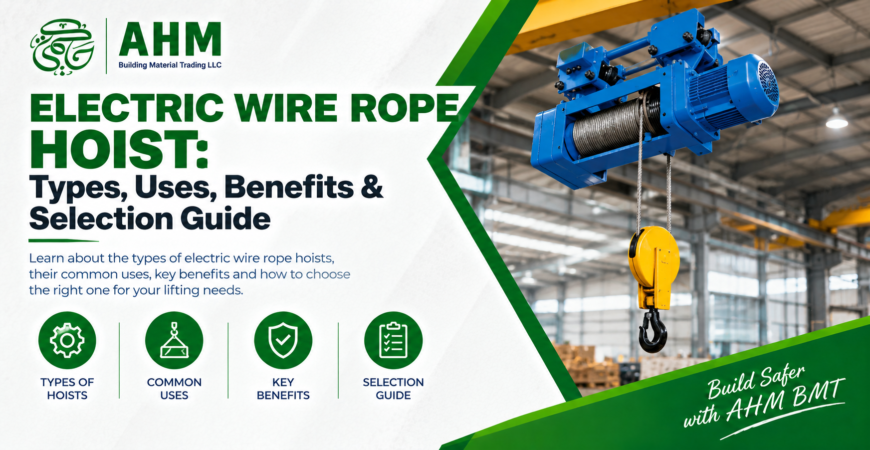
Lifting heavy materials safely and efficiently is an important requirement across construction sites, warehouses, factories, and industrial facilities. When materials need to be raised or lowered repeatedly, an electric wire rope hoist can help make lifting operations more controlled and reduce the physical effort required from workers.
An Electric Wire Rope Hoist uses an electric motor and a wire rope mechanism to lift, lower, and position loads. Its suitability depends on several factors, including load capacity, lifting height, operating frequency, installation arrangement, and the working environment. Selecting the right equipment helps businesses plan lifting operations more effectively while supporting workplace safety.
For contractors, warehouse operators, maintenance teams, and industrial buyers in Dubai and across the UAE, understanding the available hoist options and their applications is an important step before purchasing lifting equipment.
What Is an Electric Wire Rope Hoist?
An electric wire rope hoist is a powered lifting device designed to raise and lower loads using a wire rope wound around a drum. An electric motor drives the lifting mechanism, while the controls allow the operator to manage the movement of the load.
Depending on its design and specifications, the hoist may be installed as part of an overhead lifting arrangement, such as a beam, gantry, or monorail system. The supporting structure and mounting arrangement must be suitable for the intended load and lifting operation.
AHM BMT supplies an Electric Wire Rope Hoist for industrial and construction lifting applications. Its product page describes motorised operation, a wire rope and drum system, and mounting options for different overhead arrangements. Buyers should confirm the available specifications and compatibility before placing an order.
How Does an Electric Wire Rope Hoist Work?
The hoist uses an electric motor to drive its lifting mechanism. When the operator activates the appropriate control, the mechanism winds or unwinds the wire rope to raise or lower the attached load.
The main components and their roles generally include:
- Electric motor: Supplies the power needed to operate the lifting mechanism.
- Wire rope: Supports the load as part of the hoisting system.
- Drum: Stores the wire rope as it winds and unwinds.
- Control system: Allows the operator to command lifting and lowering movements.
- Hook or load attachment: Connects the load to the hoist through a suitable lifting arrangement.
- Supporting structure: Holds the hoist and transfers the imposed loads to the structure.
The exact design and components can vary between models. Always refer to the manufacturer’s documentation for the specific hoist being considered.
Types and Options of Electric Wire Rope Hoists
Electric wire rope hoists are available in different configurations. The most appropriate option depends on the load, available space, lifting height, movement requirements, and installation conditions.
1. Standard Electric Wire Rope Hoist
A standard electric wire rope hoist is used where powered lifting and lowering are required for regular material-handling tasks. It may be suitable for factories, workshops, warehouses, and construction environments, provided its capacity and configuration match the application.
Before purchasing, check the rated lifting capacity, lifting height, operating controls, mounting arrangement, and duty requirements.
2. Mini Electric Wire Hoist
A mini electric wire hoist is a compact option for lifting tasks where a smaller unit may be more suitable. The actual load capacity, lifting height, and intended operating conditions depend on the specific model.
AHM BMT also lists a Mini Electric Wire Hoist. Compare its specifications with the intended task rather than assuming that a compact model can handle the same loads as a larger industrial hoist.
3. Fixed-Mount Hoist
A fixed-mount configuration keeps the hoist in a designated position. It may be appropriate when loads are repeatedly lifted from the same work area and horizontal movement is not required from the hoist itself.
The mounting points and supporting structure must be suitable for the hoist and the maximum intended load. Installation should follow the manufacturer’s instructions.
4. Hoist Used with an Overhead Travel System
Some lifting operations require both vertical lifting and horizontal movement. A hoist may be incorporated into a compatible overhead arrangement to move loads between workstations or along a defined route.
The hoist, trolley, beam, and supporting structure must be compatible with one another. Do not assume that every trolley or overhead system is suitable for every wire rope hoist.
Common Uses of Electric Wire Rope Hoists
Electric wire rope hoists are used in several work environments where materials need to be lifted and positioned.
Construction Sites
Construction operations may involve lifting building components, equipment, and other materials. The hoist must be selected according to the weight and dimensions of the load, the required lifting height, and the conditions of the site.
Warehouses and Storage Facilities
Warehouses may use powered lifting equipment to handle heavy items and support material movement. The appropriate configuration depends on the storage layout, load-handling process, and available overhead structure.
Factories and Manufacturing Units
Manufacturing facilities may require loads to be raised or lowered during production, assembly, or equipment handling. A suitable hoist can support these activities when its capacity and duty rating match the task.
Workshops and Maintenance Areas
Maintenance teams may need to lift components during equipment servicing or repositioning. The hoist must be appropriate for the component being handled and the conditions in which the work takes place.
Industrial Material Handling
In industrial settings, hoists can support repeated lifting tasks and help reduce reliance on manual lifting. The load attachment, lifting path, operator controls, and surrounding work area should all be considered before use.
Key Benefits of Electric Wire Rope Hoists
The benefits of an electric wire rope hoist depend on its design, correct installation, and proper operation. Common advantages include the following.
Reduced Manual Effort
Powered lifting reduces the physical effort needed to raise and lower heavy loads compared with manual handling methods. This can be useful for repetitive material-handling tasks.
Controlled Lifting and Lowering
Electric controls allow operators to manage the lifting movement. Appropriate operation and clear communication help keep loads under control during lifting activities.
Support for Repetitive Operations
Where materials need to be lifted regularly, a suitable electric hoist can support a consistent workflow. Its suitability for the frequency and duration of use should be checked against the manufacturer’s duty rating.
Adaptability to Different Work Environments
Depending on its configuration and specifications, an electric wire rope hoist may be used in workshops, warehouses, factories, and construction environments.
Integration with Lifting Equipment
A hoist forms part of a wider lifting arrangement. Suitable accessories, load attachments, and compatible supporting equipment are important to the safe operation of the complete system.
For example, a wire rope sling with pressed loop and safety eye hook may be relevant to certain lifting arrangements. Its suitability must be verified for the specific load, connection points, and lifting method. It should not be treated as automatically compatible with every hoist.
Electric Wire Rope Hoist vs Other Lifting Options
Different lifting devices serve different purposes. The best choice depends on the job rather than the product name alone.
| Equipment | Main purpose | What to consider |
| Electric wire rope hoist | Powered lifting and lowering using wire rope | Capacity, lift height, duty rating, installation |
| Mini electric wire hoist | Compact powered lifting tasks, depending on model | Model capacity, lifting height, and intended use |
| Electric chain hoist | Powered lifting using a chain mechanism | Load requirements, operating conditions, and specifications |
| Manual chain block | Manually operated lifting | Available space, lifting frequency, and operator effort |
These options are not interchangeable in every situation. Review each product’s rated capacity, operating limits, and installation requirements before making a decision.
Electric Wire Rope Hoist Selection Guide: What to Check Before Buying
Selecting the right hoist requires more than comparing prices. The equipment must match the intended lifting task and the conditions at the installation site.
1. Determine the Required Load Capacity
Identify the maximum load that needs to be lifted, including any relevant lifting attachments. Select a hoist with a rated capacity suitable for the complete lifting arrangement.
Never exceed the rated capacity or use a higher-capacity assumption based on appearance alone. If the load weight is uncertain, confirm it before selecting the equipment.
2. Confirm the Required Lifting Height
Measure the vertical distance the load needs to travel. Check that the hoist’s available lift height is suitable and that sufficient clearance is available above and below the load.
Consider the space needed for the hoist, hook, lifting attachment, and load throughout the movement.
3. Check the Mounting Arrangement
Determine whether the hoist will be fixed in place or used with an overhead travel system. The supporting beam, gantry, or monorail must be designed for the loads involved.
Confirm compatibility with the intended installation before ordering the equipment.
4. Review the Power Supply and Controls
Check the electrical supply required by the selected model and ensure the site can provide it. Ask for the relevant information about motor specifications, control arrangements, and operating requirements.
Electrical installation should be completed by appropriately qualified personnel.
5. Consider Operating Frequency
A hoist used occasionally may have different requirements from equipment operating throughout a production shift. Review the duty rating and the manufacturer’s recommendations for operating frequency, rest periods, and maintenance.
Do not assume that every electric hoist is suitable for continuous heavy-duty use.
6. Inspect the Wire Rope and Lifting Attachments
The wire rope, hook, sling, and other load-handling components must be appropriate for the intended operation. Check their rated capacities, condition, compatibility, and inspection requirements.
AHM BMT also lists wire ropes in its product range. The correct rope and lifting accessories must be selected according to the equipment design and application, rather than substituted without technical confirmation.
7. Assess the Working Environment
Consider exposure to dust, moisture, temperature, corrosion, and other site conditions. Confirm that the selected equipment is suitable for the actual environment and that any applicable protection requirements are addressed.
8. Check Maintenance and Service Requirements
Ask for the manufacturer’s operating instructions, inspection schedule, recommended maintenance procedures, and spare-parts information. Regular checks help identify wear or damage before equipment is returned to service.
9. Verify Safety Requirements
Before purchasing, confirm the applicable workplace requirements and the documentation available for the specific model. Operators should be trained, loads should be properly secured, and the lifting area should be controlled.
Never allow people to stand beneath a suspended load, and never use a hoist to lift people unless the equipment is specifically designed and approved for that purpose.
Basic Maintenance Tips for an Electric Wire Rope Hoist
Maintenance should follow the manufacturer’s instructions and the site’s lifting-equipment inspection procedures. General checks include:
- Inspect the wire rope: Look for visible damage, broken wires, deformation, corrosion, or other signs requiring assessment.
- Check the hook and attachments: Look for damage, distortion, cracks, or problems with safety latches where fitted.
- Review the controls: Check that controls operate as intended and that any abnormal behaviour is investigated.
- Listen for unusual sounds: Stop operation and arrange an inspection if the hoist develops unexpected noise or movement.
- Follow lubrication instructions: Use only the maintenance methods and lubricants specified by the manufacturer.
- Keep inspection records: Record inspections, maintenance, and any issues found, in accordance with the applicable procedures.
- Remove unsafe equipment from service: Do not continue using equipment with suspected defects until it has been assessed and cleared by a competent person.
Maintenance must be performed by appropriately qualified personnel. Never attempt repairs while the equipment is energised or a load remains suspended.
Electric Wire Rope Hoist and Related Products from AHM BMT
AHM BMT, formally A H M Building Materials Trading LLC, supplies construction and industrial products in Dubai, UAE. Its product range includes lifting equipment, rigging products, hardware tools, safety equipment, and other site supplies.
Customers can review the AHM BMT product catalogue to see the wider range of available products. For a lifting requirement, begin with the intended load, lifting height, operating frequency, and installation arrangement, then confirm the specifications and availability of the relevant equipment with the supplier.
When enquiring about an electric wire rope hoist, be ready to share:
- The maximum load to be lifted.
- The required lifting height.
- Whether the hoist will be fixed or travel horizontally.
- The available power supply.
- The expected frequency of operation.
- The work environment and installation details.
Providing these details helps the supplier assess which available model may suit the application. Confirm the final specifications, rated capacity, accessories, and installation requirements before purchase.
Conclusion
An Electric Wire Rope Hoist can support material handling in construction, manufacturing, warehouses, and industrial facilities by providing powered lifting and lowering. However, its effectiveness depends on selecting the correct capacity, lift height, mounting arrangement, duty rating, and compatible accessories.
Before purchasing, review the application carefully, confirm the manufacturer’s specifications, and establish a suitable inspection and maintenance plan. For businesses in Dubai and across the UAE, AHM BMT provides a product range that includes electric wire rope hoists and related lifting and rigging items. Contact the supplier to check product availability and confirm the requirements for your intended lifting operation.
FAQs:
1. What is an electric wire rope hoist used for?
An electric wire rope hoist is used to raise and lower loads with a motorised wire rope mechanism. Applications may include construction, warehouses, factories, workshops, and industrial material handling, depending on the equipment specifications.
2. How do I choose the right electric wire rope hoist?
Start by determining the maximum load, required lifting height, operating frequency, mounting arrangement, power supply, and working environment. Compare these requirements with the manufacturer’s specifications before selecting a model.
3. What is the difference between a wire rope hoist and a chain hoist?
A wire rope hoist uses a wire rope wound around a drum, while a chain hoist uses a load chain. The right option depends on the lifting application, required specifications, installation, and operating conditions.
4. What is a mini electric wire hoist?
A mini electric wire hoist is a compact powered lifting device intended for tasks suited to its particular model. Check its rated capacity, lift height, and operating limitations before use.
5. Can an electric wire rope hoist be installed on an overhead beam?
Some models are designed for overhead installations, including suitable beams, gantries, or monorails. The specific hoist and supporting structure must be compatible and rated for the intended loading arrangement.
6. What should I check before buying an electric wire rope hoist?
Check load capacity, lifting height, duty rating, power supply, mounting requirements, controls, wire rope condition, compatible attachments, documentation, and maintenance requirements.
7. How often should an electric wire rope hoist be inspected?
Inspection frequency depends on the manufacturer’s instructions, operating conditions, usage, and applicable workplace requirements. Follow the required inspection schedule and arrange additional checks whenever damage or abnormal operation is suspected.
8. Is an electric wire rope hoist suitable for continuous operation?
Not every model is designed for continuous operation. Confirm the manufacturer’s duty rating, operating limits, and maintenance requirements before using a hoist for frequent or extended lifting cycles.
9. Where can I find an electric wire rope hoist in Dubai?
AHM BMT lists an electric wire rope hoist on its website and is based at Naif Bazaar Center, Nakheel, Dubai, UAE. Contact the supplier to confirm availability, specifications, and pricing.
10. What information should I provide when requesting a hoist quotation?
Provide the required lifting capacity, lifting height, operating frequency, mounting arrangement, available power supply, work environment, and any accessory requirements. These details help establish whether the available equipment is suitable for the job.