
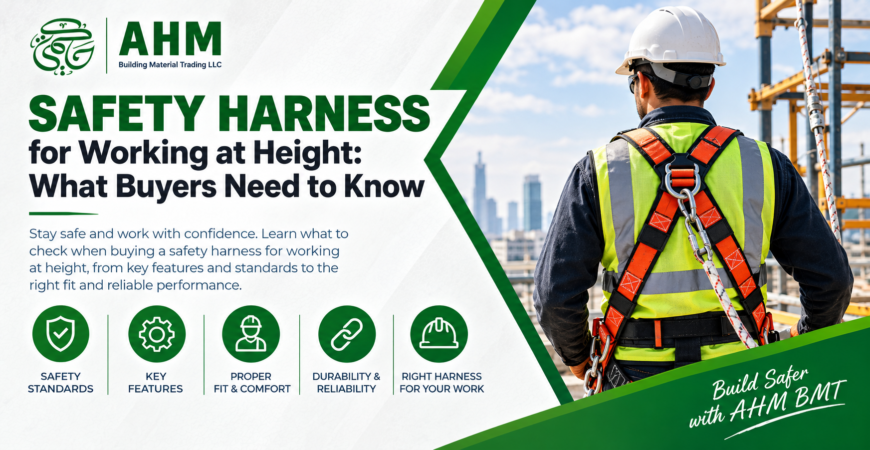
Working at height is a regular part of construction, building maintenance, industrial operations, and other site activities. These tasks can expose workers to serious fall hazards, making the correct personal protective equipment (PPE) essential. A Safety Harness is an important part of a fall protection system, helping secure a worker when used with compatible equipment and an appropriate safety procedure.
For contractors, procurement teams, and site managers in Dubai and across the UAE, buying a suitable harness involves more than comparing prices. Fit, connection points, intended application, compatibility, inspection requirements, and applicable safety standards all need attention before placing an order.
AHM BMT supplies safety equipment for construction and industrial applications, including harness options for working at height. This guide explains what buyers should consider when selecting a harness and how to identify the right option for their workplace.
What Is a Safety Harness?
A safety harness is wearable protective equipment designed to secure a worker as part of a suitable fall protection system. Depending on the equipment and its intended use, it may help prevent a worker from reaching a fall hazard or help arrest a fall when connected to a compatible system.
Harnesses are used in activities such as construction, scaffolding work, building maintenance, and other jobs where workers may be exposed to falling risks.
However, a harness alone does not provide complete fall protection. The system must be appropriate for the task and may require compatible lanyards, connectors, suitable anchorage, and a rescue plan. Workers also need proper training on fitting, connecting, and inspecting the equipment.
Why Is a Safety Harness Important for Working at Height?
Working at height can involve exposed edges, elevated platforms, scaffolding, and other areas where a slip or loss of balance may result in a fall. The right protective equipment helps address these risks when used as part of a planned safety system.
1. Helps Protect Workers from Fall Hazards
A properly selected and correctly connected harness forms part of a fall protection system. The system must be designed for the specific work activity and used according to the manufacturer’s instructions.
2. Supports Safer Construction Activities
Construction workers may need to work on elevated structures, install equipment, or perform maintenance above ground level. Selecting suitable protective equipment helps site managers address fall hazards before work begins.
3. Supports Workplace Safety Procedures
Employers and site supervisors need to identify risks, select appropriate protective equipment, and ensure workers understand how to use it. Harness inspection, correct fitting, training, and safe work procedures are all important parts of this process.
4. Provides a Practical Option for Different Tasks
Harness requirements can vary depending on whether a worker needs to be prevented from reaching an edge or protected against a potential fall. The correct equipment should be selected according to the work environment and the intended fall protection method.
Types of Safety Harnesses Buyers Should Know
The terms used for harnesses can vary by manufacturer. Buyers should focus on the equipment’s intended purpose and the complete system in which it will be used.
1. Full-Body Safety Harness
A full-body harness is designed to secure the worker around the body and is commonly used in personal fall arrest systems. Its fit, attachment points, and compatibility with other equipment must meet the requirements of the task.
Before purchasing, confirm the manufacturer’s instructions, approved application, and applicable safety requirements.
2. Single-Hook Safety Harness Setup
A harness supplied with a single-hook connection may suit certain work arrangements, depending on the design and intended application. The connection must be compatible with the anchorage or other equipment used in the system.
Buyers should not assume that a single-hook setup is suitable for every task involving movement at height. The work method and risk assessment should determine the appropriate configuration.
3. Double-Hook Safety Harness Setup
A double-hook configuration may support certain work activities where the worker needs to manage connections while moving between approved anchorage points. Its suitability depends on the harness, connectors, anchorage arrangement, and manufacturer’s instructions.
Using two hooks does not automatically make a setup safe for every situation. Workers must understand the correct connection sequence and avoid unprotected movement.
AHM BMT lists a double-hook safety harness for buyers reviewing this type of equipment.
Safety Harness Comparison Table
The following table outlines common buying considerations. These are general selection guidelines, not a claim that every harness design is suitable for every application.
| Harness option | Potential application | What buyers should verify |
| Full-body harness | Work requiring a body-worn fall protection system | Fit, attachment points, approved use, and system compatibility |
| Single-hook configuration | Tasks where a suitable single connection is specified | Connector compatibility and the approved work method |
| Double-hook configuration | Tasks that require a suitable two-connector arrangement | Correct connection procedure, anchorage requirements, and manufacturer guidance |
The product description alone should not determine the purchase. Confirm the required configuration with the supplier and the person responsible for workplace safety.
Key Features to Check Before Buying a Safety Harness
Before placing an order, evaluate the equipment against the requirements of the worksite rather than relying on appearance or price alone.
1. Correct Fit and Adjustability
A harness must fit the intended wearer correctly. Poor adjustment can affect comfort and the way the equipment performs during use.
Check the available sizing information, adjustment points, and manufacturer’s fitting instructions. Workers should be trained to put on and adjust the harness before entering a work-at-height area.
2. Attachment Points and Connectors
Attachment points are important because they determine how the harness connects to the rest of the fall protection system. Confirm the approved attachment point for the intended application and whether the connectors and lanyard are compatible.
Never assume that every attachment point can be used for every purpose.
3. Material Condition and Worksite Suitability
The harness should be appropriate for the conditions in which it will be used. Consider the work environment, exposure to dirt or abrasive surfaces, and any substances or conditions that could damage the equipment.
Inspect the harness for wear, cuts, damaged stitching, deformation, or other signs of deterioration. Follow the manufacturer’s instructions for cleaning, storage, and service life.
4. Applicable Safety Standards
Ask the supplier for the relevant product documentation and confirmation of the standards applicable to the intended use. Do not rely on a general product description as the only evidence of compliance.
Requirements may differ depending on the workplace, project specifications, and local regulations.
5. Compatibility with Other Equipment
A harness should be treated as one component of a complete system. Check compatibility with the lanyard, connector, anchorage, and any energy-absorbing components required for the task.
The complete arrangement should be reviewed by a competent person to ensure it is suitable for the planned work.
How to Choose the Right Safety Harness for Your Project
For contractors and procurement teams, a clear purchasing process can help reduce the risk of ordering equipment that does not meet the worksite requirements.
Step 1: Identify the Work Activity
Start by defining the job. For example, construction, scaffolding, exterior maintenance, and elevated installation work may have different hazards and movement requirements.
Step 2: Assess the Fall Risk
Determine whether the work can be planned to avoid exposure to an edge or whether a fall protection system is required. Where suitable, preventing access to the hazard may be preferable to relying on a system that arrests a fall.
A competent person should assess the task and identify the appropriate protection method.
Step 3: Confirm the Required Harness Configuration
Once the risk assessment is complete, identify the required harness type and attachment arrangement. Confirm whether a single-hook or double-hook configuration is appropriate, rather than selecting one based only on price or availability.
Step 4: Review Product Information
Before purchasing, request details about sizing, intended use, attachment points, applicable standards, inspection requirements, and compatibility with the other components of the system.
For reference, AHM BMT lists a standard safety harness on its website. Buyers should confirm the current specifications and suitability for their application before ordering.
Step 5: Consider the Complete PPE Requirement
Work at height may require additional PPE depending on the site hazards. Head protection is one example: AHM BMT also lists a safety helmet for construction and industrial work. The helmet and harness should each be selected for their intended protective function.
Step 6: Confirm Availability and Pricing
For project or bulk requirements, provide the supplier with the required quantity, intended application, and any project specifications. Confirm current stock, product details, and pricing before finalising the purchase.
Safety Harness Inspection and Maintenance Tips
Regular inspection is essential because a harness can be damaged through use, storage, or exposure to unsuitable conditions. Always follow the manufacturer’s instructions and the site’s inspection procedure.
Use these practical checks:
- Inspect before use: Check webbing, stitching, buckles, connectors, and attachment points for visible damage or deterioration.
- Check the fit: Ensure the harness is adjusted correctly and all buckles are secured according to the instructions.
- Review connected equipment: Check the lanyard, hooks, and other system components for compatibility and damage.
- Remove damaged equipment from service: Do not use a harness with visible defects or one that has been involved in a fall until it has been handled according to the manufacturer’s requirements.
- Store correctly: Keep the harness in suitable storage conditions and away from anything that could damage its materials.
- Maintain inspection records: Follow the workplace procedure for recording checks, defects, and equipment replacement.
A visual check alone may not identify every type of damage. If the harness’s condition or history is uncertain, seek guidance from the manufacturer or a competent person before using it.
Common Mistakes to Avoid When Buying a Safety Harness
Even when a product appears suitable, overlooking important details can create problems during use. Buyers and site managers should avoid the following mistakes:
- Buying based only on price: Low cost does not establish suitability or compliance.
- Ignoring fit and sizing: A harness must fit each wearer according to the manufacturer’s instructions.
- Assuming all hooks are interchangeable: Connectors and attachment points must be suitable for the complete system.
- Overlooking training: Workers need to know how to fit, inspect, connect, and use the equipment correctly.
- Using damaged equipment: Harnesses with defects or uncertain service histories should not be used without appropriate assessment.
- Forgetting rescue planning: A fall protection plan should address how a worker will be rescued promptly if a fall occurs and the worker remains suspended.
Avoiding these mistakes helps buyers make more informed decisions and supports a safer work-at-height procedure.
Safety Harness and Related Products Available from AHM BMT
AHM BMT supplies construction and industrial products, including safety equipment for workplace applications. Buyers can review the company’s product catalogue to view its wider range of supplies.
For work-at-height purchasing, the following listed products may be relevant to a broader PPE and equipment assessment:
- Safety Harness: For reviewing body-worn fall protection equipment.
- Double-Hook Safety Harness: For tasks where a compatible double-hook configuration is specified.
- Safety Helmet: For head protection where required by the site risk assessment.
- Tool Lanyard: For managing the risk of tools falling from elevated work areas when the selected lanyard is suitable for the tool and task.
The tool lanyard is not a substitute for a personal fall protection system. It serves a different purpose, so buyers should assess it separately from equipment intended to protect a worker from falling.
For current stock, pricing, and product specifications, contact AHM BMT before ordering. The supplier is located at Shop No. 36, Naif Bazaar Center, Nakheel, Dubai, UAE.
Conclusion
Buying a Safety Harness for working at height requires careful attention to the task, the worker, and the complete fall protection system. Fit, attachment points, equipment compatibility, product documentation, inspection procedures, and worker training all contribute to safer use.
Contractors and procurement teams should confirm the required configuration before ordering and ensure that the selected equipment matches the worksite’s risk assessment and applicable safety requirements. AHM BMT provides safety equipment options for construction and industrial applications, allowing buyers to enquire about products that may suit their project needs.
FAQs:
1. What is a safety harness used for?
A safety harness is wearable protective equipment used as part of a suitable fall protection system. Depending on the system design, it may help prevent a worker from reaching a fall hazard or arrest a fall when connected to compatible equipment.
2. Which safety harness is suitable for working at height?
The suitable harness depends on the task, the fall risk, the required connection arrangement, and the rest of the protection system. Buyers should assess the work requirements and follow the manufacturer’s guidance before selecting a product.
3. What is the difference between a single-hook and double-hook safety harness?
The main difference is the connector configuration. A single-hook setup uses one hook connection, while a double-hook setup has two. The appropriate configuration depends on the work method, anchorage arrangement, and manufacturer’s instructions.
4. What should I check before purchasing a safety harness?
Check the fit, intended application, attachment points, connector compatibility, product documentation, applicable standards, inspection requirements, and suitability for the work environment.
5. Can a safety harness be used without a lanyard?
A harness needs to be used as part of a suitable system for the intended application. Where a lanyard or another connecting component is required, it must be compatible with the harness and the rest of the system.
6. How often should a safety harness be inspected?
Inspect the harness before use and follow the manufacturer’s inspection schedule and the workplace’s procedures. Equipment should also be assessed after an incident or whenever damage is suspected.
7. When should a safety harness be replaced?
A harness should be removed from service if it shows damage, has been involved in a fall, or has an uncertain condition or history. Follow the manufacturer’s requirements for assessment, retirement, and replacement.
8. Is a safety helmet also needed when working at height?
A helmet may be required to address head-injury hazards identified in the site risk assessment. It protects against different hazards from a harness, so the two items should be selected according to their intended purposes.
9. Where can I buy a safety harness in Dubai?
Buyers can contact AHM BMT in Dubai to enquire about its listed safety harness products, current availability, specifications, and pricing. Confirm that the product meets the requirements of the intended work before placing an order.