
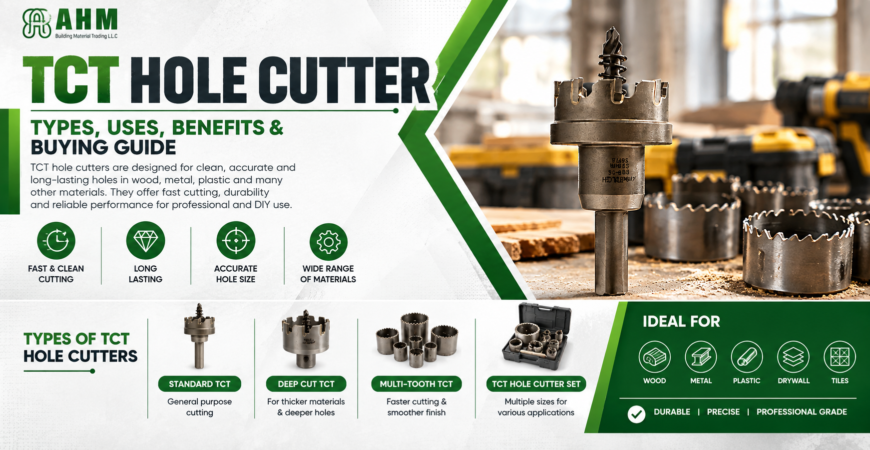
A TCT hole cutter creates clean, accurate holes in metal, wood, plastic, and other suitable materials. Its tungsten carbide teeth provide durable cutting performance and help professionals produce consistent openings with less effort.
For contractors, fabricators, electricians, plumbers, HVAC technicians, and maintenance teams in Dubai and across the UAE, AHM BMT supplies professional cutting tools designed for demanding construction and industrial applications. AHM BMT offers TCT hole cutters alongside a wider range of construction consumables, helping professionals source essential tools from one supplier.
Choosing the right TCT hole cutter requires more than selecting a diameter. You should consider the material, thickness, required hole size, cutting depth, arbor compatibility, machine, and application. The correct selection improves cutting efficiency, hole accuracy, and tool life.
This guide explains what a TCT hole cutter is, how it works, where professionals use it, and how to choose the right option.
What Is a TCT Hole Cutter?
A TCT hole cutter is a circular cutting tool that uses tungsten carbide-tipped teeth to create round holes.
TCT stands for Tungsten Carbide Tipped. Tungsten carbide provides high hardness and wear resistance, making TCT cutting tools suitable for many demanding applications.
Unlike a conventional drill bit, a hole cutter removes material around the circumference of the hole. This design leaves the central plug intact until the cutter completes the opening.
A typical TCT hole cutter consists of:
- Tungsten carbide cutting teeth
- Cylindrical cutter body
- Pilot drill
- Arbor or mounting system
- Shank
The pilot drill guides the cutter into the workpiece. The carbide teeth then remove material around the required diameter.
AHM BMT’s TCT Holesaw provides a tungsten carbide-tipped cutting solution for suitable professional applications.
How Does a TCT Hole Cutter Work?
A TCT hole cutter works by combining a pilot drill with carbide-tipped cutting teeth.
First, the pilot drill contacts the workpiece and establishes the cutting position. As the machine rotates, the TCT teeth engage the surrounding material and gradually create the circular opening.
The cutter removes significantly less material than a conventional twist drill because it cuts only the circumference.
This design can provide several practical advantages:
- Faster large-hole creation
- Reduced material removal
- Consistent hole diameter
- Efficient cutting
- Suitable performance across various materials
Actual performance depends on the cutter design, workpiece, machine, cutting conditions, and manufacturer’s specifications.
What Materials Can a TCT Hole Cutter Cut?
One of the major advantages of TCT technology involves its versatility.
However, not every TCT hole cutter suits every material. Always check the product specifications before cutting.
Metal
TCT hole cutters can suit various metal applications, depending on the cutter specification.
Professionals may use suitable cutters on:
- Mild steel
- Stainless steel
- Aluminium
- Sheet metal
- Metal panels
- Fabricated components
For dedicated metal applications, AHM BMT also supplies a metal holesaw range.
Wood
Suitable TCT hole cutters can create larger openings in timber and wooden boards.
Carpenters and installers may use them for:
- Cable routing
- Pipe openings
- Furniture work
- Cabinet installations
- General construction
Always select the appropriate tooth configuration for the wood and thickness.
Plastic
A suitable TCT hole cutter can also work with certain plastics.
Controlled cutting helps prevent unnecessary melting, cracking, or deformation.
Machine settings and cutting technique should follow the tool manufacturer’s recommendations.
Composite Materials
Some TCT cutters can work with suitable composite boards and panels.
Because composite materials vary considerably, check the cutter’s compatibility before beginning the job.
TCT Hole Cutter vs Standard Hole Saw
Both tools create circular holes, but their cutting construction can differ significantly.
| Feature | TCT Hole Cutter | Conventional Hole Saw |
| Cutting material | Tungsten carbide tips | Depends on design |
| Wear resistance | Generally high | Varies |
| Cutting applications | Metal, wood, plastic and suitable materials | Depends on tooth type |
| Large-hole work | Excellent for suitable applications | Commonly used |
| Durability | High when correctly selected | Depends on construction |
| Material compatibility | Product-specific | Product-specific |
A TCT hole cutter can provide a strong option when you need durable carbide cutting teeth.
However, the best tool depends on the workpiece and application rather than the cutter name alone.
What Are the Main Uses of a TCT Hole Cutter?
TCT hole cutters support a wide range of professional applications.
Electrical Installation
Electricians frequently create openings for:
- Cable routes
- Conduit
- Electrical boxes
- Control panels
- Cable glands
Accurate holes help installers achieve cleaner cable and conduit installations.
Plumbing
Plumbers use suitable hole cutters to create openings for pipes and fittings.
The correct diameter provides enough clearance while avoiding unnecessarily large holes.
Always measure the actual pipe dimensions and required installation clearance before cutting.
HVAC Installation
HVAC contractors often need openings for pipes, ducts, vents, and service connections.
Larger TCT cutters can support suitable applications where the workpiece and cutter specification match.
Metal Fabrication
Fabricators use hole cutters to create openings in metal sheets and panels.
A suitable carbide cutter can help produce accurate holes without removing the entire center as a conventional drill would.
Carpentry and Woodworking
Carpenters use hole cutters for larger openings in timber, boards, and suitable composite materials.
They can support furniture, cabinetry, construction, and installation work.
How Do You Choose the Right TCT Hole Cutter?
Selecting the right cutter requires several checks.
1. Determine the Hole Diameter
Start with the finished hole diameter.
Measure the component that needs to pass through the opening and consider the required clearance.
Do not choose a cutter simply because its diameter looks close to the required size.
For pipes, cables, fittings, and electrical components, check the installation specification first.
2. Identify the Material
The workpiece determines the cutter you need.
Ask:
- Is it steel?
- Is it stainless steel?
- Is it aluminium?
- Is it wood?
- Is it plastic?
- Is it a composite panel?
Then confirm that the selected TCT cutter supports that material.
3. Check Material Thickness
Hole cutter diameter does not determine cutting depth.
A cutter may create the correct diameter but still fail to complete a thick workpiece if its cutting depth does not meet the application.
Check the manufacturer’s stated cutting depth before purchasing.
4. Check the Arbor
The cutter must work with the selected arbor.
Check:
- Arbor type
- Shank compatibility
- Pilot drill compatibility
- Chuck capacity
- Machine type
A correctly selected cutter still requires a compatible mounting system.
5. Consider the Machine
The drilling machine must support the cutter’s requirements.
Before operation, check the manufacturer’s recommended machine type, speed range, and maximum permitted RPM.
Never exceed the cutter’s marked maximum speed.
TCT Hole Cutter Size Guide
The required diameter depends on the application.
| Hole Diameter Range | Typical Applications |
| 14–25 mm | Small cables, conduits and fittings |
| 26–40 mm | Electrical and plumbing installations |
| 41–60 mm | Pipes, fittings and service openings |
| 61–80 mm | HVAC and larger pipework |
| 81–100 mm | Larger service penetrations |
| 100 mm+ | HVAC, industrial and specialized openings |
These ranges provide general guidance rather than universal specifications. Actual cutter availability and application suitability vary by product.
What Are the Benefits of a TCT Hole Cutter?
A correctly selected TCT hole cutter can provide several practical benefits.
Durable Cutting Teeth
Tungsten carbide provides high hardness and wear resistance.
This makes TCT cutting teeth suitable for demanding applications when users select the correct cutter for the material.
Efficient Large-Hole Cutting
A hole cutter removes only the material around the circumference.
This can make large-hole creation more efficient than using a conventional drill bit that removes the entire hole volume.
Consistent Hole Diameter
The circular cutting design helps produce consistent openings when users maintain proper alignment and cutting technique.
This matters when pipes, cables, fittings, or components need accurate clearance.
Multi-Material Versatility
Suitable TCT hole cutters can work across several material categories.
This versatility benefits contractors who handle different materials during a project.
Reduced Material Removal
The cutter does not grind away the entire center of the hole.
Instead, it produces a central plug that can be removed after completing the cut.
TCT Hole Cutter vs Metal Hole Saw vs Glass Hole Saw
Different hole saw products serve different materials.
| Tool | Primary Application |
| TCT Hole Cutter | Metal, wood, plastic and suitable materials |
| Metal Hole Saw | Metal cutting applications |
| Glass Hole Saw | Glass and suitable tile-related applications |
| General Hole Saw | Depends on tooth design and material |
AHM BMT provides different cutting solutions so professionals can select a product based on the material rather than using one cutter for every application.
For specialized glass applications, AHM BMT offers a glass holesaw.
What Is the Difference Between TCT and Bi-Metal Hole Saws?
TCT and bi-metal hole saws use different cutting constructions.
A TCT hole cutter uses tungsten carbide-tipped teeth. The carbide tips provide high hardness and wear resistance.
A bi-metal hole saw typically combines different metals within the cutter body and cutting edge to balance flexibility, toughness, and cutting performance.
Neither option automatically suits every application.
Choose according to:
- Material
- Thickness
- Hole diameter
- Cutting frequency
- Required durability
- Machine
- Manufacturer recommendations
For demanding applications, compare the actual product specifications rather than relying only on the cutter category.
How to Use a TCT Hole Cutter Correctly
Proper technique improves hole quality and helps protect the cutting teeth.
Mark the Hole Center
Mark the exact center before drilling.
Accurate positioning prevents unnecessary rework.
Secure the Workpiece
Secure the material firmly.
Movement during cutting can cause vibration, inaccurate holes, and damage to the cutter.
Start With the Pilot Drill
The pilot drill establishes the cutting position.
Keep the machine controlled while the pilot bit engages the surface.
Maintain Controlled Pressure
Avoid forcing the cutter into the material.
Excessive pressure can increase heat, vibration, and tooth wear.
Let the cutting teeth remove material at a controlled rate.
Clear Chips When Necessary
Metal and other materials can generate chips during cutting.
Clear debris safely when required and follow the tool manufacturer’s instructions.
Common TCT Hole Cutter Mistakes
Even a high-quality cutter can perform poorly when users select or operate it incorrectly.
Using the Wrong Cutter for the Material
Do not assume every TCT hole cutter works with every material.
Check the product specification first.
Choosing the Wrong Diameter
An incorrectly sized hole can create installation problems.
Measure the required opening before purchasing the cutter.
Ignoring Material Thickness
Always confirm that the cutter can handle the workpiece thickness.
Applying Excessive Force
Heavy pressure can increase heat and accelerate tooth wear.
Controlled pressure usually provides better tool management.
Ignoring RPM
Operating above the permitted speed can create a serious safety risk.
Always follow the manufacturer’s maximum RPM rating.
Using a Damaged Cutter
Inspect the cutter before use.
Do not use a tool with damaged teeth, body, arbor, or other defects.
TCT Hole Cutter Safety Guide
Hole cutting can generate sharp chips, dust, noise, and heat.
Professionals should follow appropriate site safety procedures and wear PPE suitable for the material and application.
Recommended precautions include:
- Wear suitable eye protection.
- Use hearing protection where required.
- Use appropriate respiratory protection when the work generates hazardous dust.
- Secure the workpiece.
- Use the correct machine guard.
- Inspect the cutter before installation.
- Keep hands away from the rotating cutter.
- Follow the manufacturer’s operating instructions.
- Never exceed the marked maximum RPM.
When cutting metal, allow chips to clear safely. Do not handle hot chips immediately after cutting.
How Can You Extend TCT Hole Cutter Life?
Correct maintenance can help preserve cutting performance.
Use the Correct Application
Match the cutter with the material it was designed to cut.
Avoid Excessive Pressure
Let the carbide teeth perform the cutting instead of forcing the machine.
Control Heat
Excessive heat can affect cutting performance and accelerate wear. Follow the manufacturer’s recommendations for the material and tool.
Store the Cutter Properly
Keep the cutter clean and protected from unnecessary impact.
Inspect the Teeth
Check the carbide tips regularly for damage or excessive wear.
Replace Worn Components
Do not continue using a cutter after it reaches an unsafe or ineffective condition.
Why Choose AHM BMT for TCT Hole Cutters in UAE?
AHM BMT serves contractors, builders, engineers, maintenance teams, fabricators, and procurement professionals across Dubai and the UAE.
The company focuses on supplying building materials, hardware tools, consumables, safety equipment, rigging products, and other construction essentials.
Professional Cutting Tool Range
AHM BMT provides different hole saw and cutting options for different applications.
Its range includes:
- TCT hole saws
- Metal hole saws
- Glass hole saws
- Other construction consumables
This range allows professionals to select products according to the actual material and job requirements.
TCT Hole Saw Availability
AHM BMT’s TCT hole saw provides a carbide-tipped cutting option for suitable applications.
The product can support professionals who need durable cutting performance across compatible materials.
Metal Cutting Options
For projects that specifically involve metal, AHM BMT also provides metal hole saw options.
This gives fabricators and contractors another option when selecting a suitable cutting tool.
Broader Construction Consumables
A hole cutter rarely represents the only consumable required on a project.
AHM BMT’s broader consumables range helps professionals source additional construction and industrial products through one supplier.
Practical Product Support
Choosing the right cutter requires attention to diameter, material, thickness, machine compatibility, and application.
AHM BMT can help customers evaluate these requirements before selecting a suitable product.
Conclusion
A TCT hole cutter provides an efficient way to create accurate circular openings in suitable materials. Tungsten carbide-tipped teeth provide hardness and wear resistance, making these cutters valuable for construction, fabrication, electrical, plumbing, HVAC, and maintenance applications.
However, selecting the correct cutter requires more than choosing a diameter. Material type, thickness, cutting depth, arbor compatibility, machine specifications, and operating conditions all influence performance.
For contractors and industrial buyers in Dubai and the UAE, AHM BMT offers TCT hole saws, metal hole saws, glass hole saws, and a broader range of construction consumables. Choosing the right product for the application helps improve cutting efficiency, accuracy, and overall project productivity.
FAQs
Q1. What is a TCT hole cutter?
Ans. A TCT hole cutter is a circular cutting tool with tungsten carbide-tipped teeth. It creates round openings in suitable materials.
Q2. What does TCT stand for?
Ans. TCT stands for Tungsten Carbide Tipped. The carbide tips provide hardness and wear resistance.
Q3. What materials can a TCT hole cutter cut?
Ans. Depending on the product, TCT hole cutters can work with metal, wood, plastic, and suitable composite materials.
Q4. Is a TCT hole cutter better than a standard hole saw?
Ans. A TCT cutter can provide greater durability and suitable performance for demanding applications. The best option depends on the material and job.
Q5. How do I choose the right TCT hole cutter size?
Ans. Measure the required finished hole diameter, then check material, thickness, clearance, machine compatibility, and cutter specifications.
Q6. Can I use a TCT hole cutter on stainless steel?
Ans. Some TCT hole cutters are suitable for stainless steel, but you must confirm the manufacturer’s material recommendation before cutting.